Building Routines, Chores & School Organisation That Actually Work
Raising responsible kids isn't about reminding them fourteen times before school. Responsibility is a skill children build through structure, not lectures. When the week is visible and chores are shared, kids learn to plan, follow through and look ahead, and the daily nagging quietly fades. This is a calm, practical look at how a chore chart NZ families can actually keep up with helps, plus less mental load for you.
I lost count years ago of how many times I'd say "have you packed your bag?" before 8am. Same question, same kid, same panic, every single morning. What finally changed things in our house wasn't a stricter tone or a better bribe. It was making the week visible, so the answer lived on a board instead of in my head. Raising responsible kids in Aotearoa starts there, with structure they can see, rather than reminders they tune out. Responsibility isn't a personality some children are born with and others miss. It's a skill, and like any skill, it's built through repetition.
Responsibility Is a Skill, Not a Personality Trait
I used to think some kids were just "the organised type" and ours weren't. I've learnt that's not really how it works. Responsibility is what psychologists call executive function: the brain's planning and self-management system. The Education Hub explains executive function as the set of skills that let us plan, focus attention, remember instructions and finish tasks, built on three things working together: working memory, cognitive flexibility and inhibitory control (resisting distraction).
Here's the part that helped me most. Those skills don't switch on just because a child gets older. They develop because they get used, over and over. So when my daughter checks the board, packs her own gear or works out when her test is, she isn't just being helpful. She's literally strengthening the wiring she'll lean on as a teenager. The board became a scaffold: something that holds the skill up until she can hold it herself.
What Executive Function Actually Looks Like at Home
This can all sound very theoretical, so let me bring it back to the kitchen bench. Executive function is a kid remembering to bring the lunchbox inside instead of leaving it festering in the bottom of the bag for three days (we have lived this). It's a Year 6 student knowing the maths test is Thursday instead of being ambushed by it. It's a teenager laying out their uniform the night before tournament day.
When kids forget, it's so easy to read it as not caring. Most of the time it isn't. A child who forgets repeatedly usually has a working memory that's still catching up. A teenager who leaves an assignment until the night before often isn't lazy, they just haven't built the habit of starting early or judging how long things take. Visible structure fills that gap while their brain develops. Instead of relying on a wobbly internal memory, they rely on a cue they can see. Over time the cue does its job and the habit sticks.
How Chores Build the Brain (Yes, Really)
I'll be honest, I used to feel a bit guilty handing my kids chores while I was flat out, like I was offloading. Turns out chores are doing real work for them. A 2022 study in the Australian Occupational Therapy Journal found that engagement in everyday chores predicted children's working memory and inhibitory control, even after accounting for age. The tasks that mattered most were self-care and family-care ones, like making themselves a meal or making one for someone else.
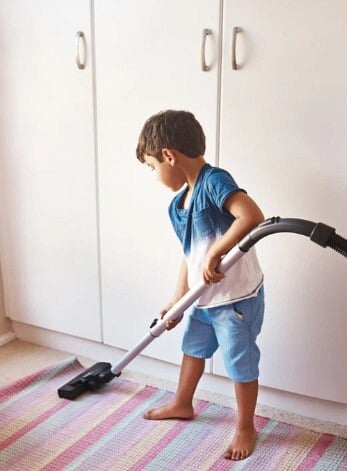
It makes sense when you think about what a chore actually demands. To empty the dishwasher properly, you have to hold the steps in your head, ignore the phone buzzing and keep going when it's boring. That's planning, self-control and follow-through, practised in real life. An age-appropriate chore chart that you actually keep up with isn't really about a tidy house (mine certainly isn't tidy). It's repetition that slowly turns into capacity, and capacity that slowly turns into character.
Visible Routines Mean Less Daily Conflict
Most of our arguments never used to happen over big things. They happened in the gaps: getting out the door, homework time, the slow march to bed. Those moments all need planning and self-regulation, which are exactly the skills still under construction in kids. Ambiguity makes them worse. A visible routine takes the ambiguity away.
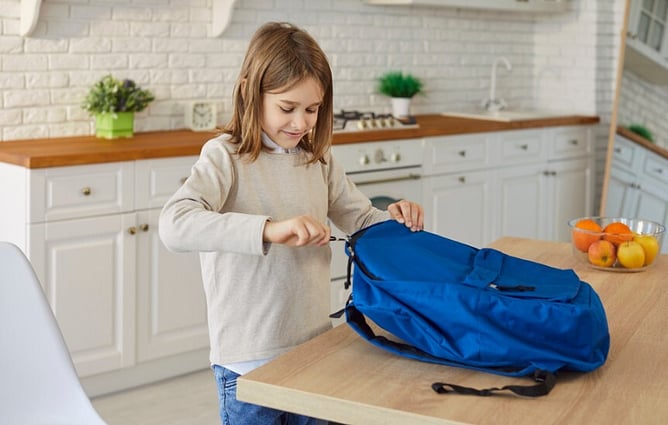
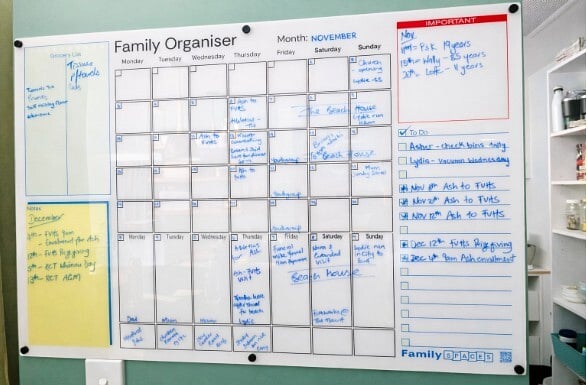
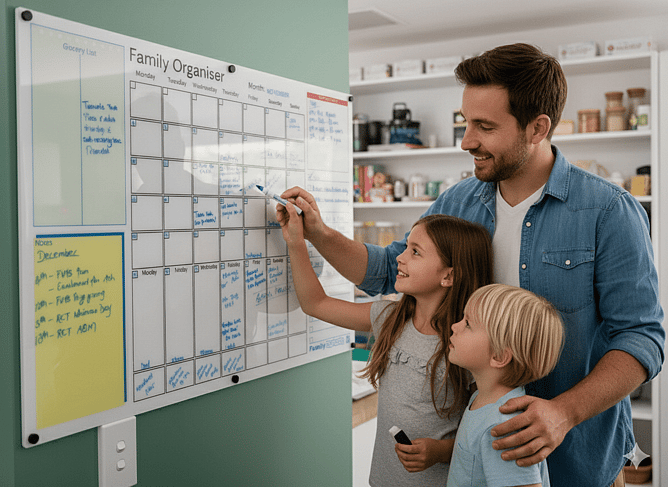
In our house, mornings now follow the same simple run: bed made, teeth done, bag packed, glance at the board. After school it's bag unpacked, homework, gear sorted, check tomorrow. None of it is clever. The power is in it being the same every day. The best bit is I stopped being the human reminder. Instead of "have you done it yet?" for the hundredth time, I can ask "what's next on the board?" The system carries the expectation, not my voice, and that takes a surprising amount of heat out of the room. A simple family organiser board does a lot of this quiet work for you.
Homework, Planning and the Art of Looking Ahead
A homework planner does more than list assignments. Used daily, it teaches kids to work out what to do first, guess how long something will take, break a big project into chunks and plan backwards from a deadline. When a school project lives across a few weeks on the board, research, draft, finish, a child starts to see that a scary task is just a series of small ones. They stop reacting to deadlines and start anticipating them.
That's the whole game, really: removing the surprise. Planning lowers stress not because it adds more to do, but because it spreads the effort out so nothing lands as a 9pm shock. These are slow-burn skills. They don't show up in a week. They show up in Year 9, when it suddenly counts.
The Intermediate to Secondary Jump, Where It All Pays Off
If there's one pressure point I'd flag for NZ families, it's the move from Intermediate to secondary school. At primary and intermediate, teachers do a lot of the remembering for our kids. Then secondary hits: multiple teachers, a rotating timetable, overlapping assignments, more sport, more everything. The organisational load jumps almost overnight.
Kids who've already practised writing deadlines down, breaking projects into stages and glancing at a planner each day tend to take that jump in their stride. It's still a step up, but a manageable one. Kids who've never had that visible scaffolding can hit a wall, and that's usually when parents find themselves checking portals and chasing assignments late at night. The difference isn't brains. It's preparation. By the time NCEA arrives, those quiet little habits from Year 3 and Year 6 are doing a lot of heavy lifting. For more on protecting your own energy through it all, this guide on how to survive the NZ school year without burnout sits right alongside this one.
Sharing the Mental Load With the Whole Whānau
Here's the bit closest to my heart. The reason most of this coordination falls on one person is that it's invisible. The Ministry for Women's work on unpaid labour reflects what so many of us already feel in our bones: women carry a much larger share of the unpaid work at home, women spent around four hours 20 minutes a day on it compared with two and a half for men in the time-use data. And that's before you count the cognitive part: the remembering, the anticipating, the tracking of who needs what and when.
When all that planning lives only in one head, it's almost impossible for anyone else to see its weight, let alone help carry it. When it's on the board, it becomes shared knowledge. The kids can check what's coming. Luke can see what needs prepping. It stops being my private burden and becomes something the whole house can see and pitch in on. That's not about chasing a perfect, colour-coded home. It's about partnership, and partnership is what actually protects you.
It's worth knowing too that all this busyness is real and not in your head. The Growing Up in New Zealand study found two thirds of children take part in organised team sport at least weekly. Between sport, kapa haka, music and everything else, the calendar fills fast. Coordination is genuine work, and it deserves to be shared.
What This Builds Over the Long Run
I try not to get too starry-eyed about any of this, but the long view is encouraging. Children who grow up doing age-appropriate responsibilities tend to become more organised, more reliable and better at problem-solving. The goal was never perfectly behaved kids who do as they're told. Compliance fades the moment you leave the room.
What lasts is identity. When a child grows up in a home where expectations are visible and contributing is just normal, they start to see themselves as someone who looks ahead, prepares and follows through. They become a contributor to family life rather than a passenger being managed. That self-image is what walks with them into flatting, study and work, long after they've stopped needing the board at all.

Calmer Mornings Start With What's on the Board
If your mornings still feel like that fourteen-reminders scramble, you don't need a personality transplant for your kids or a stricter version of yourself. You just need the week somewhere everyone can see it. Start small: one routine, one chore each, one shared place to look. Let the board do the reminding for a while, and watch how slowly the asking turns into them just knowing.
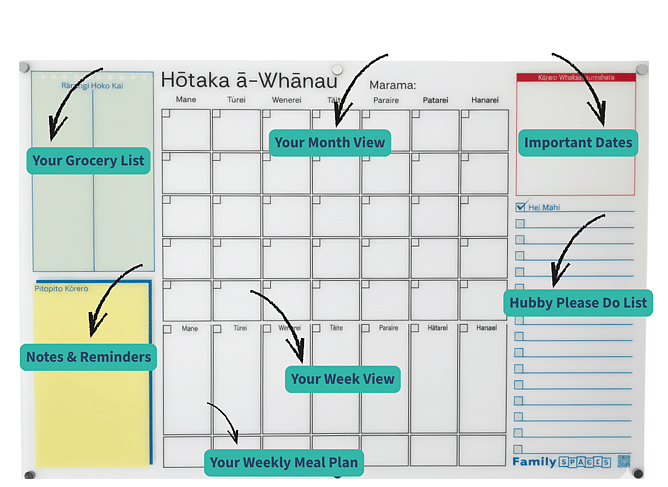
If you'd like a ready-made nudge, our Planning Panels are designed right here in Aotearoa for exactly this, in English and te reo Māori, built to live on the wall and be wiped clean week after week. Or start free with our Weekly Reset planner and see how it feels to get it out of your head and onto a board. Clarity creates calm, and that's a gentle place to begin.
Frequently Asked Questions
At what age should kids start doing chores in NZ?
Earlier than most of us expect, honestly. Even three and four year olds can put toys away or help set the table, and the research links self-care and family-care chores to stronger thinking skills in children aged five and up. Keep the task small and matched to their age, and aim for consistency over perfection. The point isn't a spotless house, it's the practice.
What's the best chore chart for a NZ family?
The best chore chart is the one you'll actually keep using, sitting somewhere everyone passes daily. A visible board works far better than an app buried in a phone, because the whole whānau can see it at a glance and the routine becomes shared rather than nagged. Whether it's a printable like our Weekly Reset or a wipe-clean Planning Panel, choose what fits your wall and your week.
How do I get my kids to do chores without nagging?
Take yourself out of the loop. When the expectation lives on a visible board instead of in your voice, you can ask "what's next on the board?" rather than repeating the same reminder. The system carries the expectation, which removes a lot of the friction between you and your child. It won't be perfect overnight, but the nagging genuinely fades over time.
Do chores really help kids do better at school?
There's good evidence they help with the underlying skills. A 2022 New Zealand-relevant study found everyday chores predicted children's working memory and self-control, which are the same skills behind planning homework and finishing tasks. Chores teach kids to follow multi-step instructions and push through boring bits, and that transfers straight into schoolwork.
How do I prepare my child for the jump to secondary school?
Build the habits early, while the stakes are low. Get them used to writing deadlines down, breaking projects into stages and checking a planner every day during their primary and intermediate years. By the time they're juggling multiple teachers, a rotating timetable and NCEA, those routines feel normal instead of overwhelming. A visible homework planner or family board makes the whole shift far less of a shock.