
A Practical Guide for Busy Kiwi Mums and Whānau
Surviving the New Zealand school year isn't about being more organised or trying harder. The school year moves in predictable waves across four terms, and the mental load of holding it all together usually lands on one person. This is a gentle, practical look at why it feels so heavy, and how making the week visible (instead of carrying it in your head) protects your energy term after term.
The school year never seems to arrive quietly. One week we're still in holiday mode, slow mornings and no alarms, and the next I'm standing in the kitchen at 7:43am hunting for a missing shoe while half-drafting a reply to a school notice I read at 10pm the night before. New teachers, new sport sign-ups, new emails, packed lunches, all at once.
Surviving the New Zealand school year, I've learnt, isn't about willpower. At work I sit inside proper systems: shared calendars, clear roles, everyone can see what's happening. At home during term, it can feel like I am the system. If you feel capable in one place and constantly behind in the other, that's not a personal flaw. It's a structural load.
The mental load isn't a personal failing
When the term feels relentless, it's so easy to decide the problem is you. I should be more organised. More on top of it. Better at this.
But it isn't really about discipline. Across Australia, the Australian Institute of Family Studies has found mothers are far more likely than fathers to carry the mental load of coordinating family life. Here in Aotearoa, Stats NZ's Time Use Survey shows women still do considerably more unpaid work, the housework, childcare and the quiet running of the household, than men.
On paper those findings sound neutral. In real life they're very tangible. Household management isn't just cleaning and cooking. It's reading every school email before anyone else has opened it. Noticing the uniform's getting tight before the complaint comes. Remembering swimming starts in Week 4, tracking sport fees, anticipating mufti days and teacher-only days and early finishes that all seem to land in the same week.
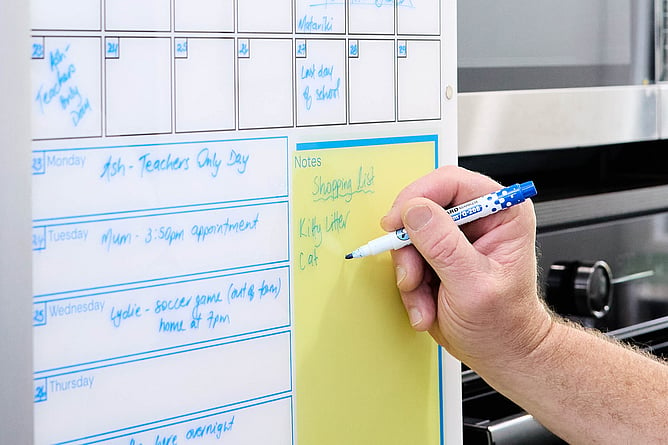
It's being the default anticipator. And that work leaves no evidence. There's no folded pile to point at, no finished job. It just runs constantly in the background, which is exactly why it wears you down so quietly. Not because you lack capability, but because you're functioning as infrastructure with no structural support behind you. One nervous system was never meant to hold all of that alone.
Burnout builds through tiny decisions
Burnout rarely starts with one disastrous Monday. It builds through hundreds of small, repeated questions every single day.
Do we have bread? Whose turn is pickup? Is sport cancelled because of the rain? Did I reply to that email? What's for dinner? Has the uniform dried? Did everyone pack their PE gear?
None of those are dramatic on their own. They're ordinary, even a bit boring. But together they all need attention, and attention isn't unlimited. Psychologist Roy Baumeister's well-known work on decision fatigue showed that making decisions draws on the same mental energy we use for self-control. Every small choice, even a low-stakes one, dips into the same reservoir you rely on to stay patient and respond kindly when things get hard.
So by Wednesday evening, it's not that you've run out of resilience. It's that your cognitive energy is simply spent. That's why a small thing can tip you over at 8:12pm when someone suddenly mentions a project due tomorrow.
Here's the part that helped me most: many of those decisions don't need to be made in the moment at all. They repeat, weekly and predictably. When dinner's decided in advance, that 5pm question disappears. When pickup is written down, nobody renegotiates it mid-afternoon. When sport cancellations go on a shared planner, you're not scanning three group chats while stirring pasta. You don't need stronger willpower. You need fewer invisible decisions competing for your attention.
The school year moves in waves, not a straight line
The school year in Aotearoa doesn't run in a flat line. It moves in waves, and when we forget that, we read every spike as evidence we can't cope. When you can see the pattern, something steadier settles in.
Term 1 is adjustment. New teachers, new class dynamics, swimming blocks, sport registrations, camps, permission slips, the quiet work of rebuilding routine after a summer of freedom. Even excited kids are spending real energy adapting. It feels front-loaded because it is.
Term 2 shifts the pressure rather than easing it. Winter sport begins properly. Mornings are dark and cold, wet uniforms take forever to dry, and illness moves steadily through the classrooms. The novelty has worn off, but the commitments haven't.
Term 3 carries a quieter strain. Fatigue gathers, motivation dips, assignments get heavier. Teenagers especially can hit a mid-year slump as the academic expectations climb. It isn't chaos so much as cumulative effort.
Term 4 compresses everything. Assessments, exams, prizegivings, performances, end-of-year events and the Christmas build-up all stacked together. The calendar tightens and the costs climb at the same time.
When you recognise the intensity is seasonal, not a sign you're falling behind, the question changes. You stop asking "Why does this always feel so hard?" and start asking "What does this term actually need?" Term 1 might need more admin visibility. Term 2, lower expectations on the extras. Term 3, more rest. Term 4, deliberate simplifying. Planning with the rhythm, rather than against it, lets steadiness replace self-blame.
Visibility takes the load out your head
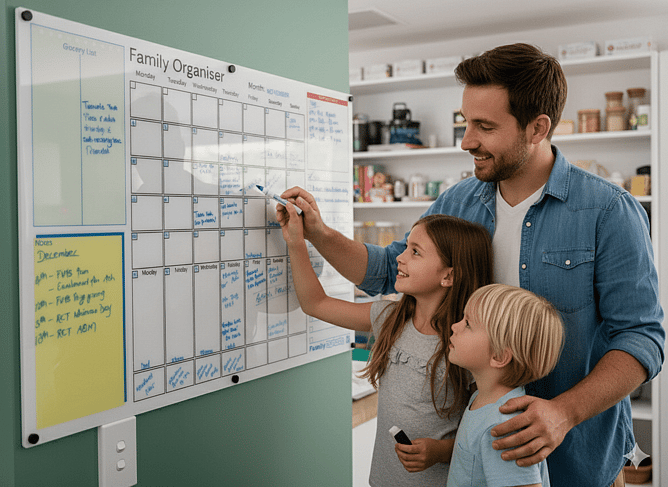
When commitments live only in your head, they don't sit quietly in a corner waiting to be recalled. They float. They resurface while you're driving, while you're trying to fall asleep, while you're standing in the supermarket wondering if you've forgotten something. That's overload, and it builds whenever your brain is asked to hold and rehearse a stack of future tasks at once.
A visible cue changes that. Instead of remembering, you refer. Instead of mentally carrying the week, you put it somewhere stable and let it sit there. The information leaves your working memory, and that's not cosmetic, it genuinely lifts the weight.
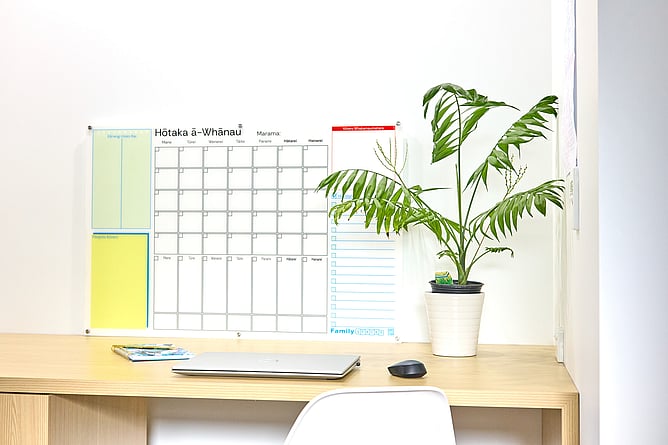
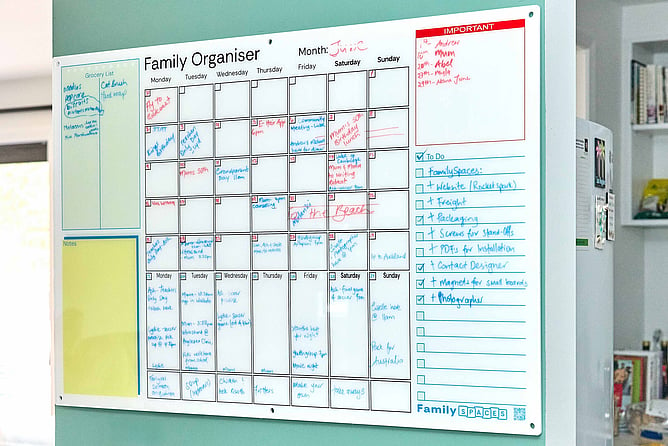
When a planner is mounted somewhere central, the kitchen wall, the hallway, wherever the family naturally gathers, the kids can see what's coming without asking. Luke can see what needs preparing without being prompted. The week stops being private knowledge held by one person and becomes shared information. The conversation shifts from "Have you packed your bag?" to "What does the planner say about tomorrow?"
Digital calendars are genuinely useful for adults coordinating work. But they live inside phones, they need to be opened on purpose, and they're invisible to a teenager walking past the fridge. A wall planner brings the week into shared physical space, so there's an ambient awareness even when nobody's actively talking about it. That's exactly the kind of quiet structure I had in mind when we designed our Planning Panels for real, busy households, where the focus is everyday usability, not just looking nice. If you're new to the idea, this simple guide to family organiser boards is a gentle place to start.
Plan one week at a time, not the whole term
One of the fastest ways to overwhelm yourself is to try to hold the entire term in your head. Ten weeks of sport draws, assessments, swimming blocks, appointments and birthday parties blur into one big urgent mass. When the horizon stretches that far, the brain struggles to prioritise and just feels heavier.
So shrink the horizon. Bring it back to one week. Psychologist Peter Gollwitzer's research on implementation intentions shows that naming exactly when, where and how something will happen makes you far more likely to follow through . A vague intention ("we'll sort dinner out during the week") just creates ongoing mental noise. A specific one ("Tuesday is pasta, Thursday is leftovers, sport pickup is confirmed") closes the loop and quietens the head.
Planning seven days is so much easier than planning seventy. A weekly reset, often a Sunday afternoon for me, acts like a little pressure valve. You look ahead deliberately rather than getting ambushed midweek. Write the dinners down so 5pm stops being a daily negotiation. Confirm pickups so nobody's texting in confusion at 3pm. Reset the school bags so stray notices don't surprise you on a Monday. Check uniforms before the rush.
This isn't about controlling every variable. It's about reducing avoidable friction, and that small bit of preparation creates breathing space. Patience usually doesn't vanish because we're incapable. It vanishes because we're overloaded. The term might be ten weeks long, but you only ever need to manage the next seven days
The emotional load counts too
The school year isn't only logistics. It's easy to focus on uniforms and notices and lunches because those are the visible bits, but underneath every term runs an emotional current that's just as demanding.
Friendships shift. Class dynamics change. Expectations climb. Social comparison gets sharper, especially as kids move into intermediate and secondary school, where belonging can feel fragile and very personal. These pressures rarely announce themselves. They show up as a child who suddenly doesn't want to go to training, a teenager who snaps over something small, a quiet withdrawal after school.
When we only look at the year through a planning lens, we miss that parallel current. And when emotional load piles on top of logistical load, home feels heavier than it needs to. Emotional support doesn't have to mean long, therapy-style talks. Often it's just regular, low-pressure check-ins: "What are you looking forward to this week? What feels tricky? What would make tomorrow easier?" Five minutes of connection on a Sunday can save thirty minutes of escalation on a Wednesday.
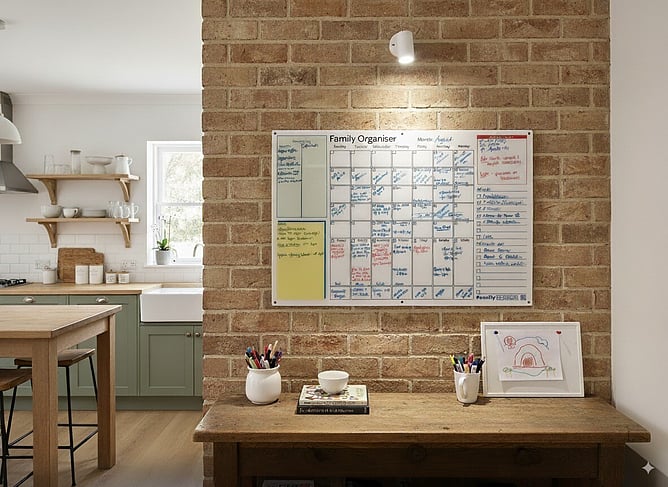
And this is where a visible system quietly helps the emotional side too. When the week is up on the wall, assessments, sport, the school disco, a child can see a busy week coming and prepare for it mentally instead of feeling ambushed by a speech they forgot about. Calmer mornings don't come from tighter control. They come from steadier systems that reduce surprise.
Money pressure stacks on top, term by term
The school year doesn't run in a bubble. It overlaps with grocery prices, petrol, winter power bills, sport registrations, uniform replacements and kids who outgrow their shoes overnight. On paper most of these costs are predictable, swimming happens every year, winter sport returns, camps land in roughly the same term. What usually creates the stress isn't the cost existing. It's the timing and the surprise.
Money pressure doesn't only hit the bank balance, it hits the nervous system. When financial pressure and time pressure arrive together, small disruptions feel bigger than they are and patience runs thin. The thing that intensifies it all is surprise: a camp notice found the night before it's due, a sport fee remembered after registration closes, a uniform that doesn't fit two days before term starts. Surprise compresses time, and compressed time multiplies pressure.
Visible planning interrupts that. When key dates go up weeks ahead, the financial rhythm of the term becomes something you can see. You notice swimming and winter sport overlap. You know Term 4 always costs more. You can spread the preparation across a few weeks instead of reacting in one stressful moment. Planning doesn't remove the expense, but it restores a bit of agency, and the costs stop feeling like isolated shocks.
There's a quiet modelling effect here too. Our kids learn how to handle pressure by watching us. When school costs are anticipated and calmly named ("camp's coming up in three weeks, so we'll get ready for it"), they absorb a steadier lesson: that planning comes before spending, and pressure can be managed through visibility rather than avoidance.
Infrastructure, not willpower
Most of us tell ourselves the same story at the end of a hard term. Next term I'll just be more organised. I'll try harder. I'll get up earlier. As if the answer lives in personal discipline.
But motivation fluctuates. Energy fluctuates. Life fluctuates. Infrastructure doesn't. At work you don't rely on memory and good intentions alone, you rely on shared calendars and defined roles, because systems exist precisely because human capacity is limited. Home deserves the same respect.
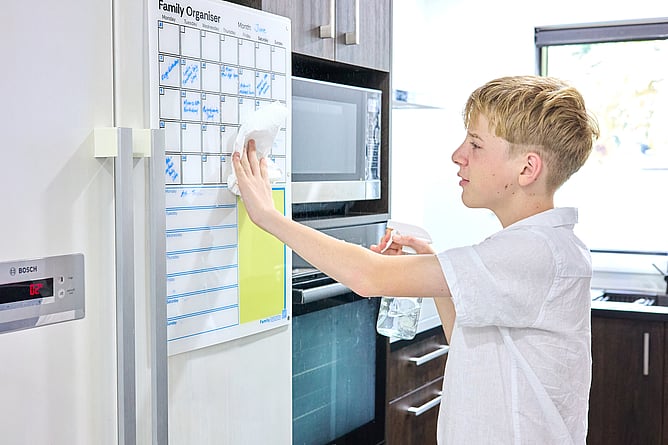
When the running of family life depends on one person remembering everything, that person becomes the infrastructure, and a nervous system was never built to be a permanent admin hub. A visible planner shifts the load from internal memory to external structure. It cuts the repeated conversations because the information's already there. It cuts the micro-decisions because the predictable ones are already made. And it spreads awareness, because everyone can see the same week at the same time. Friction is what drains energy: the endless clarifying, reminding and reacting that happens when information is invisible. Reduce the friction, and the energy lasts. Infrastructure doesn't remove the effort. It just makes the effort sustainable.
A gentler way through the year
The New Zealand school year is not light, and it was never meant to be. It carries academic expectations, sport, shifting friendships, money pressure and the steady work of kids growing into who they are. Some weeks feel smooth, others feel relentless, and that fluctuation isn't a personal failing. It's the rhythm of the year, term by term, wave by wave.
You can't delete the busy seasons. But you can change how they land in your home. When the week is visible instead of floating in one person's head, the pressure softens, surprise reduces, and the load can finally be shared.
If you'd like a gentle place to begin, our free Weekly Reset planner gives you one calm, repeatable way to look ahead each week. And when you're ready to anchor that clarity somewhere everyone can see it, take a look at our New Zealand-designed Planning Panels and find the right fit for your whānau. You were never meant to be the operating system of your household.
Frequently Asked Questions
How do I survive the New Zealand school year without burning out?
Stop treating it as a willpower problem and start treating it as a system one. The school year moves in predictable waves across four terms, so the most helpful thing you can do is make the week visible somewhere central and plan just seven days at a time. When commitments leave your head and live on the wall, the load is far easier to share and the pressure softens.
Why does the mental load fall mostly on mums?
It's structural, not personal. Research from the Australian Institute of Family Studies found mothers carry the mental load in the large majority of households, and Stats NZ's Time Use Survey shows the same pattern of unpaid work here. So if you're carrying most of the planning and anticipating, that's a known pattern, not a flaw in you.
What's the best way to plan the school week with kids?
Keep the horizon short and the plan specific. Naming exactly when and where things will happen, rather than vaguely intending to "sort it during the week," genuinely helps everyone follow through. A short Sunday reset where you write down dinners, pickups and any big dates, then put them somewhere the whole family can see, takes most of the guesswork out of the week.
Do I really need a wall planner if I have a calendar on my phone?
Phone calendars are great for adults coordinating work, but they live inside a screen and need to be opened on purpose. A wall planner is visible to everyone walking past, including kids, so the week becomes shared awareness rather than something one person checks and relays. Many families happily use both: the phone for the fine detail, the wall for the shared picture.
How can I reduce financial stress across the school terms?
A lot of school costs are predictable once you can see them coming. Mapping key dates like swimming, winter sport and camps weeks ahead lets you spread the preparation rather than meeting each cost as a surprise. Naming costs calmly in front of the kids also models that planning comes before spending, which lowers the stress for everyone.