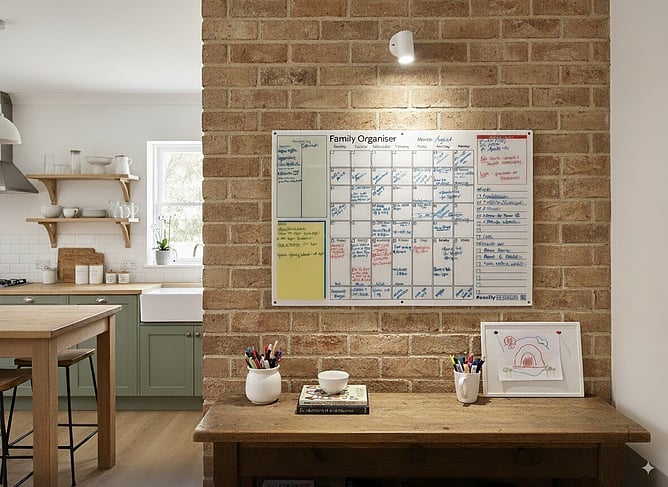
A Practical Guide for Overwhelmed Mums Who Need More Than a Calendar
A family organiser board can quietly change how your week feels, not by removing the busyness, but by getting it out of your head and onto the wall where everyone can see it. This is a calm, honest guide for the mum who is tired of being the only one holding the map: why a structured wall planner beats a blank whiteboard and the apps, how to choose the right size, and how new habits settle in by month three.
It is 7:38am. Someone cannot find their shoes. Someone else mentions, very casually, that they need a gold coin donation today. And while I am buttering toast I am also quietly working out whether the power bill will clear tomorrow, whether there is enough milk for breakfast, and whether I ever replied to that email from school. Everyone else moves through the morning. I coordinate it. If you have ever stood in your kitchen wondering how you became the only one holding all of this, a family organiser board NZ families can actually share might be the gentlest fix I know. Not because it makes life less full, but because it stops you carrying the whole thing alone.
The Tired That Doesn't Come From Being Busy
For years, I kept everything in my head. Not because I wanted to, and not because it was clever. It just slowly became the path of least resistance. One person reads the school email first. One person remembers swimming starts in Week 4. One person notices the uniform is getting tight before anyone else does. Over time, that person becomes the holder of the map.
None of it is dramatic on its own. Swimming days, camp payments, dentist reminders, whose birthday is coming up, which afternoon is double-booked three weeks from now. The strain doesn't arrive as a crisis. It builds quietly, through repetition.
It turns out there's a name for this. The sociologist Allison Daminger describes how women tend to carry the anticipating and monitoring side of family life, not just doing the task, but noticing it needs doing in the first place. That's the part that's so hard to point to. When the washing is folded, you can see it. When you mentally check whether two commitments clash and quietly shift dinner around them, there's nothing to show for it. The work disappears the moment it's done.
And it lands unevenly. Across Aotearoa, most households with dependent children now have two parents in paid work, so the home coordination gets squeezed into already full days. Stats NZ's own time use research shows women still spend more time than men on unpaid work. The numbers measure hours, though. They can't measure the 2am wake-up when you remember a form is due, or the low hum of always knowing what's next.
When It Finally All Lived On The Wall
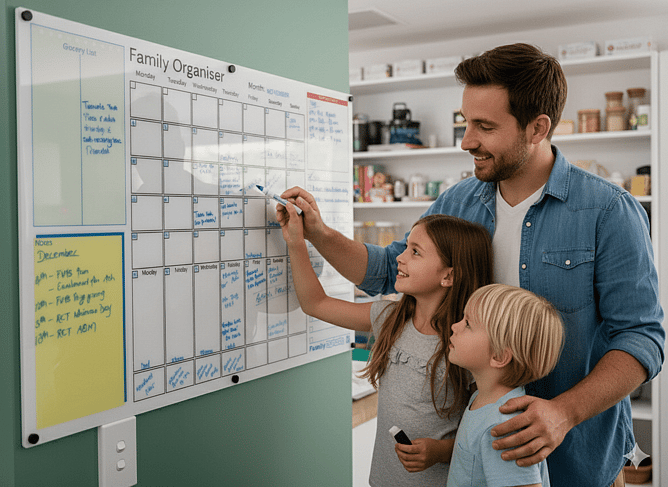
There is a very specific moment that happens when a week moves from private coordination to shared visibility.
For years, our planning didn’t live in chaos.
Here's the thing. For years our planning didn't live in chaos. It lived in fragments. Anyone who knows me will tell you I always had systems. A paper planner open on the bench. A whiteboard on the fridge for meals and groceries. A wall calendar with everyone marked in different colours. Reminders on my phone. On paper, we were organised. In reality, we were divided.
Four separate tools meant four separate sources of truth. To see the whole week, I had to cross-reference all of them and then merge it in my head. And because I was the one who knew how the pieces fit together, I became the bridge between them. That merging, that constant switching between systems, is the bit that quietly wears you down. The invisible work wasn't writing the list. It was holding all the lists at once.
The first Sunday evening our whole month went up on one Planning Panel, something shifted. Soccer training, youth group, a late work shift, swimming, a birthday on Saturday, dinners, groceries, a bill reminder. All of it, in one place, easy to read from across the kitchen. For the first time in ages I didn't have to assemble the week in my head. I could just see it.
The change wasn't really in the schedule. It was in the tone around it. "What are we doing this weekend?" became "I checked the board, do you want me to take the kids to soccer?" "What's for dinner?" became "Oh right, it's tacos." Small shifts. But small shifts compound, at 8:15am when someone packs their gear without being chased, and at 8:45pm when nobody is surprised by tomorrow's early start.
Billie put it better than I can:
"...it has been a godsend to finally have a large visual board to write all of our planning needs on... it is in Te Reo Māori! It looks amazing on the wall and in our space and has been such an asset to our family planning, I couldn't be without it." Billie, Māmā of 2, Tokoroa (Google Review, January 2026)
Finally one place. Finally visible. When the plan is visible, responsibility starts to redistribute on its own, not because anyone demanded it, but because everyone can finally see it.
Why A Structured Board Beats A Whiteboard And The Apps
Plenty of families already use paper planners and digital calendars, and there's nothing wrong with them. A diary is portable. An app sends reminders and syncs with work. The difference isn't good versus bad. It's private versus shared.
A diary lives in a bag. An app lives on a phone. A digital calendar lives behind a screen. All of them rely on one person opening them. A wall-mounted board lives in shared space, beside the fridge or in the kitchen, where everyone walks past it every day. No logging in, no scrolling, no flat battery. It simply exists in view. And if only one person can see the week, only one person can anticipate it.
A blank whiteboard looks similar, but the difference is structure. A blank board asks you to design the week every single time: redraw the headings, recreate the columns, decide how much room dinners get versus appointments. Every Sunday turns into a small design project. That's not exhausting in one go, but it's repeated effort, and repeated small decisions draw from the same patience we'd rather save for the people in front of us.
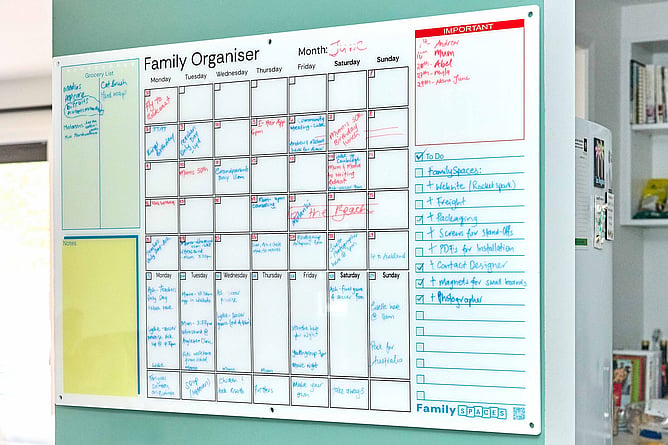
A structured panel takes that away. The layout is already there: month at a glance, the current week, flexible planning space, a to-do list, groceries, important dates, reminders. You're not deciding how to plan. You're just planning. Amy named the practical side of this:
"...I hate the traditional whiteboards as they get grubby over time but this one doesn't. The smaller size fits our fridge door nicely." Amy, Māmā of 2, Gisborne
That matters more than it sounds. If something gets grubby, it gets avoided. If it needs redesigning every week, it becomes another chore. And an unused system doesn't lighten the load. A used one does. When something is easy, it gets used, and once it gets used, it becomes rhythm.
Choosing the Right Size for Your Whānau
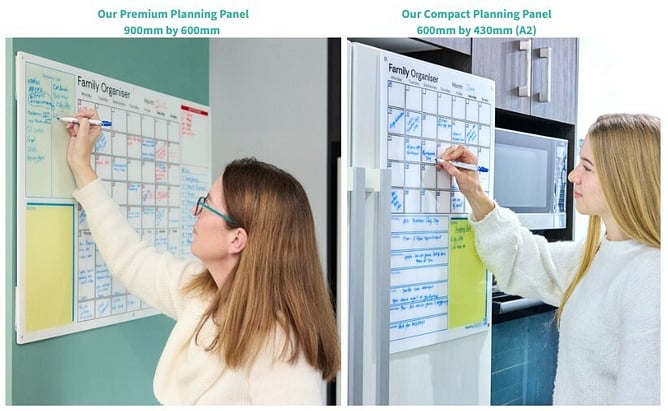
The first question people ask is usually the most practical one: how big do we need? The right size isn't about getting the biggest board. It's about legibility. When information feels squeezed, it gets ignored. When it has room, it stays usable. We make two sizes on purpose.
The Signature Planning Panel is the large one, 900mm x 600mm, nearly a metre wide. It's the true family hub, built for households where several schedules overlap and the week needs room to breathe. It holds the month at a glance, the current week, a flexible planning section, to-do list, groceries, important dates and reminders, all without crowding. For bigger families, blended households or shift-working parents, that extra margin is the whole point. It naturally becomes the spot everyone checks without thinking. It also comes in Te Reo Māori.
The Compact Planning Panel is A2, 600mm x 430mm, and gives you the same structured clarity in a smaller footprint. It's lovely for fridge mounting, apartments, smaller kitchens, couples or simpler weekly rhythms, with a month at a glance, the current week and a generous flexible reminder space. It's also available in Te Reo Māori. If the board overwhelms the wall it won't feel integrated, and if it's too small for your commitments it'll feel restrictive. The right size just feels natural in your home.
Built To Last In A Real Kitchen
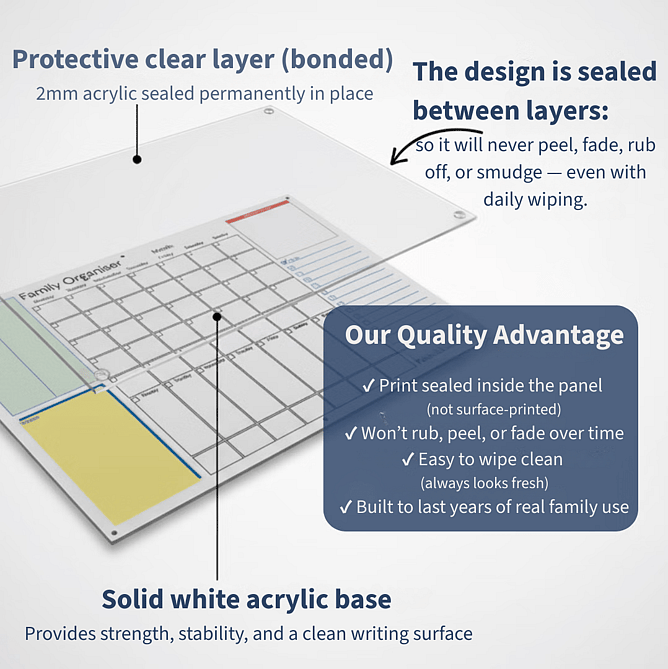
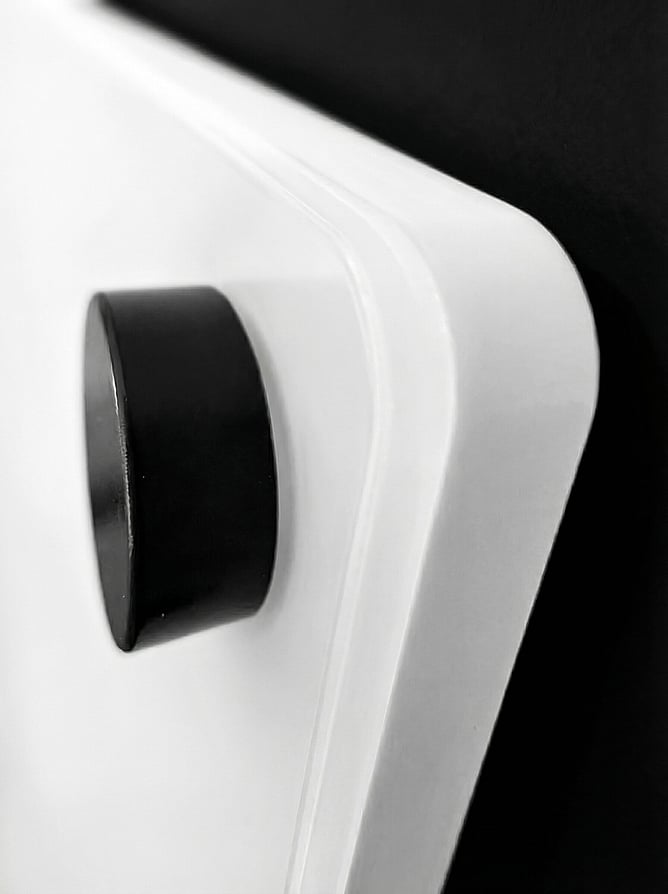
Our panels aren't a single sheet of clear acrylic. They're layered, on purpose: a 2mm clear acrylic front, the design reverse-printed and sealed behind it, bonded to a 5mm solid white acrylic backing. Because the design is sealed behind the clear layer, you're never writing on the ink. You're writing on a protective surface made to be wiped clean over and over with whiteboard markers.
The white backing matters more than you'd think. A lot of acrylic boards are fully transparent, which photographs beautifully but fights you in a real kitchen with tiled walls, coloured paint or shifting light. Marker contrast weakens and the writing gets hard to read, and a board that's hard to read gets checked less. The solid white backing keeps the contrast sharp so it stays legible from across the room, whether you're glancing over while cooking or calling out to someone packing their bag. That clarity isn't about looks. It's what keeps the whole thing usable, year after year.
Te Reo Māori, On The Kitchen Wall
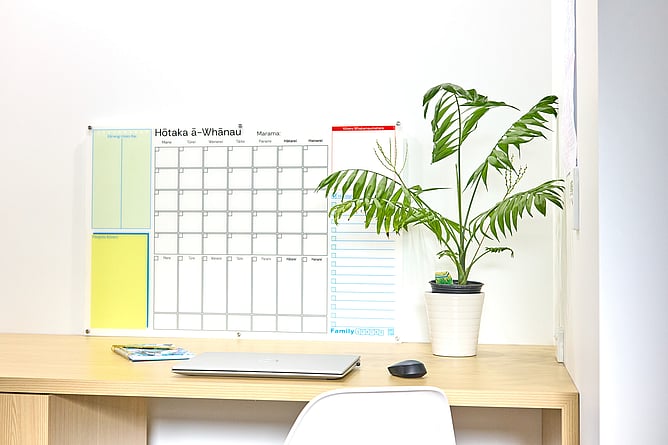
Language visibility matters, and offering our panels in both English and Te Reo Māori isn't decorative. Reo revitalisation doesn't only happen in the classroom. It happens in kitchens and hallways, in the everyday spaces where life actually unfolds. Katrina shared this:
"...As a Māori wahine, this was particularly meaningful to me, and I consider the calendar board to be a taonga within my whare." Katrina, Rotorua
That word, taonga, says something organisation alone can't. When te reo sits on the wall, the kupu are seen daily rather than ceremonially, woven into the ordinary rhythm of the week. For some whānau that's a quiet way to support the language. For others it's about seeing their identity reflected in the tools they use every day. And for others it's simply about choice. A planning system shouldn't only organise your week. It should feel like it belongs in your whare.
Budgeting And Meal Planning, Made Visible
Money pressure adds another layer to family life, especially right now. Planning isn't only sport draws and school notices. It runs straight into grocery bills, power payments and the everyday cost of keeping a household going. Financial stress rarely shows up as one big crisis. More often it's that low hum of vigilance: doing sums at the checkout, double-checking whether the power bill cleared, wondering what's left in the grocery budget for the week.
A board won't replace a budget, but it anchors awareness, which is honestly where a lot of the calm comes from. Weekly meal planning saves you negotiating dinner from scratch at 5:20pm. A visible grocery list cuts down on doubling up. A bill reminder in shared space means no nasty surprises. And when expenses sit alongside the week's schedule, you can see that sport fees and swimming land together, and adjust before the pressure builds. Missy summed up the deeper shift:
"...This board has taken the mental load off my shoulders and turned planning into a whānau habit." Missy, Te Awamutu
Notice what she names. Not savings, not perfection. Mental load, and habit. That's the real impact: financial awareness stops living in one head and becomes something the whole household can see. If you'd like a simple starting point, our free Weekly Reset planner is a gentle way to map your week before the board even arrives.
Month One vs Month Three
The first month with a panel is mostly about awareness, not transformation. You start to notice how much you'd been holding in your head, how often the same questions came up, how often you were the reminder. At first the board feels like a tool you're consciously using. You gather everyone, fill it in, refer to it on purpose.
By month three it's quieter, and more structured. The kids start checking the board before asking what's on tomorrow. Your partner glances at it before booking something new. Meal planning becomes rhythm rather than negotiation. Groceries get written down when they run out instead of forgotten. The board stops feeling like a project and becomes part of the furniture, in the best way.
That's just how habits form. They build on consistent, visible cues far more than on motivation, and a board in the same spot every day becomes exactly that cue. The household leans on reference instead of memory, and on anticipation instead of surprise. Calm doesn't come from having less to do. It comes from knowing what needs doing and when. This is the same steadiness I write about in surviving the NZ school year without burnout, and it's quietly tied to raising kids who take responsibility, because once the plan is visible, they can step into it too.
Designed In Aotearoa, For Aotearoa
Kiwi life has its own rhythm. It moves in school terms, not semesters. In regional anniversary weekends, Saturday sport draws that depend on the weather, kapa haka practices, Matariki gatherings and long summer evenings at the beach. Winter seasons where the wet uniforms never quite dry. Our panels are designed here, for those rhythms, not for American school calendars or styled Pinterest kitchens with colour-coded perfection. They're made for real homes from Kaitaia to Invercargill, where a single week might hold netball training, a late shift, youth group and a family dinner all competing for the same square. When a planning system reflects the life you actually live, it feels natural rather than imposed. And when something feels natural, it gets used.
In Closing
We didn't make Planning Panels because we love stationery. We made them because I was tired of carrying everything in my head, tired of being the bridge between four different systems while everyone else just asked, "What's happening this week?" If you're looking for a family organiser board, you're probably not really looking for acrylic. You're looking for a bit of relief from being the default planner, and from responsibility that quietly piles up unseen. A board won't cancel sport season or empty your week. But it will make the fullness visible, and once it's visible, it can be shared. Have a look through our Planning Panels and choose the size that fits your whānau. You don't have to carry it all on your own.
Frequently Asked Questions
Is the Compact A2 board big enough for a busy family?
For a lot of homes, yes. The Compact (600mm x 430mm) works beautifully when wall or fridge space is limited, or when your schedule is structured but not heavily layered. It comfortably holds a monthly overview, the current week and reminders. If you've got several kids with overlapping sport, shift work or shared parenting, the larger Signature (900mm x 600mm) gives information more room so nothing feels squeezed.
Will the marker ink stain the board?
No. The acrylic surface wipes clean easily with a soft cloth when you use standard whiteboard markers. Because you're writing on sealed acrylic rather than exposed print, nothing soaks in. With regular wiping it keeps its clarity over time.
Does the printed layout rub off?
No. The layout is reverse-printed and sealed behind the clear acrylic, then bonded to a 5mm solid white backing, so you're never writing on the design itself. It can't scratch, peel or fade with normal use and cleaning. The structure stays put year after year.
Can a board replace our digital calendar?
It works best alongside it. Plenty of families keep digital alerts for work meetings and automated reminders. The difference is visibility: a wall board creates shared awareness the whole household can see, so the week becomes something everyone references rather than something hidden in one person's phone. Digital tools notify. A wall board steadies.
Is a planning board just another organising trend?
Not really. Trends are about how something looks. This is about how a household carries responsibility. When the week is visible and shared, the mental load redistributes, the repeated questions drop away, and the tone of the week settles. That's less a trend and more a quiet shift in how the load gets carried.