How We Do Pocket Money, and the Bigger Thing Underneath It
In part one I shared how chores actually work in our house: two teenagers, one shared family board, and a lot of learning as we go. This is part two. Here's how we do pocket money for kids, what the research says about whether you should pay kids for chores, and the quieter thing sitting underneath all of it: the invisible mental load that so often lands on Mum. No perfect answers. Just what we do, honestly, and why it matters more than a tidy kitchen.
If you've ever stood in the kitchen wondering whether you should pay kids for chores, or how much pocket money is "right," or when on earth you're meant to hand over control of their money, you are in very good company. I don't have the definitive answer. What I have is a real house in Tokoroa, two teenagers, and a system we've built slowly, changed often, and got wrong plenty of times. In part one I talked about chores and what we've learned. This is the money half of the story, and then the bigger thing underneath both.
How We Do Pocket Money (the Base Amount)
Pocket money is one of those topics where everyone has an opinion. Should kids get it at all? Should it be tied to chores? How much? Save it or spend it? When do you hand over control? I won't pretend we've solved it. I'll just tell you how we think about it.
We pay a set amount each fortnight. My son gets $30, my daughter gets $40. It's paid fortnightly because that's when my salary comes in, so their contribution gets acknowledged on the same cycle mine does. The amounts reflect their ages, what's expected of each of them, and honestly, what our budget allows. I'd rather pay them what we can genuinely afford than stretch ourselves trying to keep up with what other families do.
Here's the part that matters most to me: the base amount is not up for negotiation. Just as I show up to work because it's required, they show up to their chores because it's required. The pocket money isn't payment per task. It's recognition that they're contributing members of this household. It says, quietly, you're part of how this home runs, and that counts.
What is negotiable is earning more. If they want extra, they can propose extra work. We don't always agree on the rate, but the conversation is always open. If you want more, you work for it, and advocating for yourself is a skill worth practising. I'd far rather they learn to make a case at 14 than never learn it at all.

What We Cover, and What They Fund Themselves
We've drawn a line, roughly, between needs and wants.
The basics are ours: toiletries, practical clothing, genuine needs. Those are covered, no debate. The wants are theirs to fund: the trending item, the pricier version of something perfectly good, the nice-but-not-necessary. When a friend has a birthday, we contribute $20 toward a gift, and anything above that is on them. It's almost always well over $20, because they're generous kids, and I love that about them. But the topping-up is their choice and their money.
We also give a clothing budget: a set amount twice a year, once per season, to spend however they like. When it's gone, it's gone. If they want more before the next round, it comes out of their savings. Sometimes that means a hard lesson mid-season, a beautiful jacket bought in week one and nothing left for the boots they actually needed. And I say nothing. Choices have consequences, and sometimes you learn that the hard way. I don't need to say anything. Life does the teaching.

The Bank Account Setup (yes, I know this one raises eyebrows)
I'll be honest, this is the part people react to.
Right now I have full visibility and control of both accounts. The kids have eftpos-only cards: no online payments, no PayWave. They can see their balances, but they can't move money without me. Everything goes into savings first, and I transfer what they need, when they need it.
That's deliberate. A little friction makes you think twice. When spending requires a quick conversation, you think harder about whether you actually need the thing. We're not teaching them to be dependent. We're teaching them to be intentional. There's a difference, and it's the whole point.
We pay a set amount each fortnight. My son gets $30, my daughter gets $40. It's paid fortnightly because that's when my salary comes in, so their contribution gets acknowledged on the same cycle mine does. The amounts reflect their ages, what's expected of each of them, and honestly, what our budget allows. I'd rather pay them what we can genuinely afford than stretch ourselves trying to keep up with what other families do.
There's plenty we haven't figured out. KiwiSaver. The bills conversation. How to properly teach budgeting in a way that sticks. One plan we do have: once the kids start earning their own income, even part-time, we'll charge a small amount of board and quietly put it away. So when they eventually leave home, they've got something to start with: a flat bond, maybe one day part of a house deposit. We haven't decided exactly how yet. But we will.
Should You Pay Kids for Chores? What the Research Actually Says
This is the debate people really want settled, so let me lay out both sides fairly, because both sides have a point.
The case for paying: Tying pocket money to chores teaches that effort equals reward. It's a first taste of earning, and a hands-on introduction to financial literacy. Do the work, get paid, learn to manage what you earn. For a lot of families, that link makes intuitive sense.
The case against: A family isn't an employer-and-employee relationship. Chores are simply part of being a member of a household, not a job you clock into. And paying for them risks teaching a subtle, unhelpful lesson: "what's in it for me?" The worry is that nothing gets done unless there's a dollar attached.
The people who've thought hardest about this tend to land on the "against" side, but gently. Clinical psychologist Wendy Mogel, in her writing on raising self-reliant children, frames chores as a form of family citizenship: a responsibility we hold because we belong to something, not a task we're compensated for. Working together, she argues, is exactly what builds a child's sense of obligation to the people around them.
The financial writer Ron Lieber (author of The Opposite of Spoiled, and yes, I had to double-check the name myself) takes a similar view from the money angle. In his approach to allowance, he argues that money management is too important to hold hostage to whether the dishes got done. So separate the two: kids do chores because they live here, and they get pocket money so they can learn about money. Tangle them together, he says, and you risk putting the focus on the work rather than on the far more valuable skill of learning to save, spend and give thoughtfully.
And what does the research say overall? Not that firmly on either side, which is oddly reassuring. Both approaches, done thoughtfully, tend to produce good outcomes. The worst result isn't picking the "wrong" method. It's doing neither: no responsibilities and no financial education. That's the one to avoid.
You'll notice our own setup borrows from both camps. The base pocket money isn't tied to chores (that's the Lieber and Mogel view). But we leave a door open to earn more through extra work. Messy and in-between, like most real houses. If you want more on the responsibility side of this, I wrote about it in raising responsible kids in Aotearoa.

Why This Really Isn't About the Money
Here's what I've come to believe. Pocket money isn't really about the money at all.
It's about teaching that effort has value. That choices have consequences. That independence is earned gradually, not handed over all at once. And that the people around you are worth contributing to. It's the same reason the chores matter, and the same reason the family board we all share matters. Not because I want a perfectly organised house (I've made peace with the fact that I never will), but because I want kids who understand that life takes contribution from everyone. A sense of how the world actually works. That's the whole thing.
The Bigger Thing Underneath All of This: The Mental Load
This whole two-part story started with a real conversation.
I was talking with one of my sisters-in-law, whose kids are a similar age to mine, and we went deep: chores, pocket money, expectations, our different philosophies. We laughed at ourselves. We both came away feeling validated, and not because we do it the same way (we don't), but because hearing someone's real, honest reasoning helped. It put things in perspective.
People are often surprised at how much my kids contribute, or at what I pay them. Which tells me we just don't talk about this stuff enough. And when we don't, we quietly assume everyone else has it more together than we do. So I've shared our messy in-between not as "the right way," but so you can see what it actually looks like in a real house.
And there's a bigger thing sitting underneath all of it. When my sister-in-law and I talked, what we were really circling was the load. The planning, the remembering, the organising. The stuff no one sees.
There's now solid research on this. A 2024 study from the Universities of Bath and Melbourne, published in the Journal of Marriage and Family, found that mothers carry around 71% of the household mental load: the thinking work of scheduling, planning, remembering and organising that keeps family life running. And here's the part that stopped me: even when women earn more and work longer hours, the mental load doesn't shrink. It just sits alongside everything else. Wider research backs this up. Studies have found that even women who out-earn their partners still do more of the housework and caregiving, regardless of who brings in the bigger pay packet. Most of us say it should be shared more fairly. For an awful lot of households, it still isn't.
I've been sitting with why. Our generation was the first told, loudly, that girls can do anything. And we believed it, because it's true. We went to work. We built careers. We became breadwinners. But nobody updated the other half of the script. "Having it all" so often turns out to mean doing it all: the career and the mental load and the school notices and the emotional labour, all at once, forever, without anyone quite noticing how heavy it is. I carried the guilt of working, the pressure to still do everything, the belief that a good Mum should manage it all.
And this isn't only a working-Mum problem. The mental load doesn't discriminate. Stay-at-home mums can carry an even heavier guilt, because the story becomes "this is your role, so it should all be yours to manage." Nobody wins that comparison.
But here's the thing I keep coming back to. Even before women entered the workforce, mothers weren't doing this alone. There was a village: grandmothers, sisters, neighbours, community. Women have never been meant to do this by themselves. What changed isn't that we went to work. What changed is that the village quietly disappeared, and somehow the load stayed with one person anyway. Running a home and raising children was never one person's job. It still isn't.
And our kids are watching. They're taking notes on what being an adult and running a home actually looks like. That, more than anything, is why the chores matter to me. I want my kids to grow up knowing a home runs because everyone in it shows up. Not one person. Everyone. If naming the invisible weight resonates, I wrote more about it in when did enough stop being enough.
A Gentle Note to Finish
There's no gold star at the end of this. We're still figuring it out, still changing things, still getting it wrong some weeks. If reading this makes you think "you know what, we actually do okay," then wonderful. Truly. Trust that.
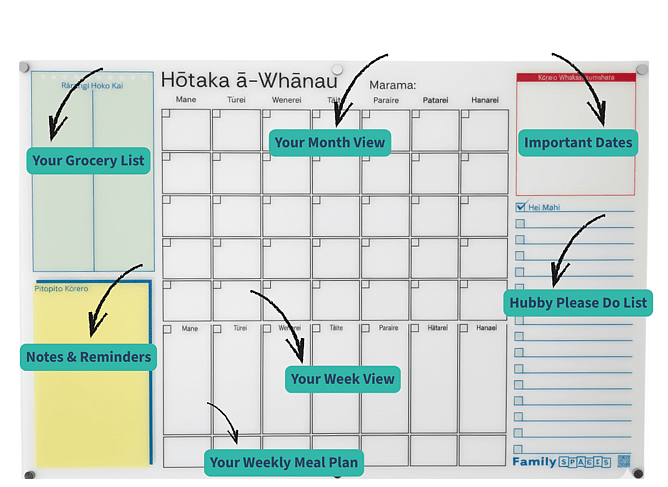
And if it sparks just one conversation in your house, about contribution, about who's carrying what, about sharing the load a little more fairly, then even better. That's the whole reason I wrote it. Making the invisible visible is what we're about, and it's the same idea behind our Planning Panels: getting the load out of one person's head and onto a board the whole whānau can see and share.
Frequently Asked Questions
Should you pay kids for chores in New Zealand?
There's no single right answer, and the research doesn't land firmly on either side. Some experts argue chores are simply part of belonging to a household and shouldn't be paid, while others see paying as a useful first lesson in earning. In our house, the base pocket money isn't tied to chores, but the kids can earn extra by taking on additional work.
How much pocket money should I give my teenager?
It depends entirely on your budget and what you expect of them, not on what other families do. We pay our 14-year-old $30 a fortnight and our 16-year-old $40, paid on the same cycle as my salary. Start with what you can genuinely afford, and let the amount reflect their age and their contribution.
Should pocket money be tied to chores or given separately?
The financial writer Ron Lieber argues for keeping them separate: kids do chores because they live there, and get pocket money so they can learn to manage money without the two becoming tangled. We mostly follow that, paying a base amount that isn't tied to tasks, while still leaving room for them to earn more through extra work. Both approaches work when done thoughtfully.
How do I teach my kids to save money?
We use a little friction on purpose. The kids have eftpos-only cards and everything goes into savings first, so spending requires a short conversation rather than a tap. It's not about control, it's about helping them pause and ask whether they actually need something. As they get older, we hand over more independence: at 16 that means a proper debit card and full responsibility.
What's the difference between needs and wants for kids?
We treat genuine needs, toiletries, practical clothing, real essentials, as our job to cover. Wants, the trending item, the pricier version, the nice-but-not-necessary, are the kids' to fund from their own money. Drawing that line clearly saves a lot of arguments and teaches them to prioritise.
What is the mental load and why does it fall on mothers?
The mental load, or cognitive household labour, is the invisible thinking work of planning, scheduling, remembering and organising family life. A 2024 study from the Universities of Bath and Melbourne found mothers carry around 71% of it, and that it doesn't reduce even when women earn more or work longer hours. Naming it, and sharing it visibly across the whole family, is the first step to lightening it.
