Building Routines, Chores & School Organisation That Actually Work
We don’t raise independent kids by reminding them fourteen times.
We raise them by giving them systems.
Children in Aotearoa are busier than ever. Between sport, kapa haka, music lessons, church, tutoring, cultural commitments and school activities, the calendar fills quickly.
The Growing Up in New Zealand study highlights the scale of participation, noting:
“Two thirds of children participated in an organised team sport at least once a week.”
https://www.growingup.co.nz
That level of engagement is fantastic for development. It builds teamwork, resilience and belonging. But it also requires coordination — and coordination is work.
At the same time, the responsibility for managing that coordination continues to sit disproportionately with women. The Ministry for Women reports:
“Women spent about 4 hours 20 minutes per day on unpaid work compared with men’s 2 hours 32 minutes.”
https://www.women.govt.nz
That unpaid work includes not only cooking and cleaning, but also the invisible cognitive labour: tracking homework, remembering sports days, organising lunchboxes, managing camps, rotating chores and constantly anticipating what’s next.
Research from the Australian Institute of Family Studies reinforces this pattern across households, noting that even in dual-income families, women continue to undertake a larger share of unpaid domestic and organisational labour. You can read about that here: https://aifs.gov.au
If we want to reduce mental load and raise responsible kids, we cannot rely on reminders alone. We need visible systems.
Responsibility is not personality. It is a skill. And skills are built through structure.
Key Takeaways
Responsibility is not a personality trait. It is a learned skill strengthened through repetition and structure.
Executive function (the brain’s planning and self-management system) develops through practice — not lectures.
Chores strengthen working memory and inhibitory control (the ability to resist distraction).
Visible planning reduces stress, household tension and the 9pm panic.
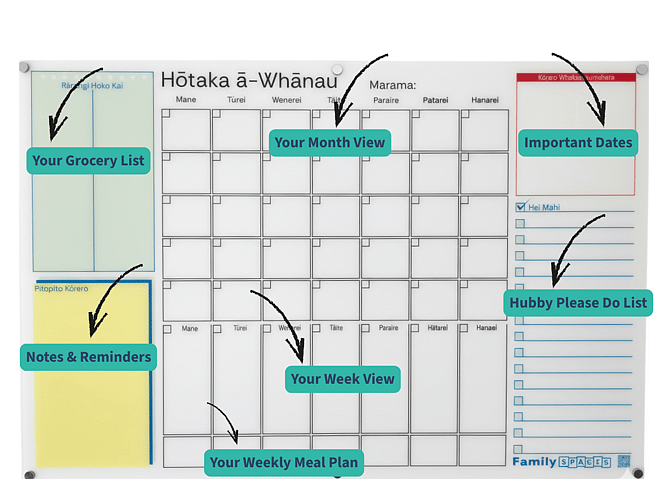
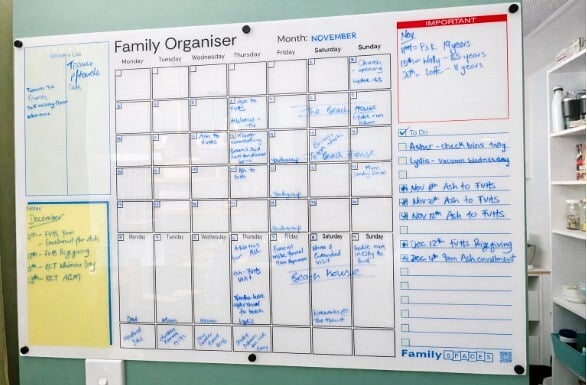
A family organiser board in New Zealand homes can shift mental load from one person to the whole whānau.
Structured routines build independence that compounds through adolescence and into adulthood.
Responsibility Is Brain Development in Action
Responsibility is not simply about keeping the house tidy or ensuring homework gets done. It is developmental. When children take responsibility for daily tasks, they are strengthening executive function — the cognitive processes that allow them to plan, organise, focus attention, remember instructions, complete multi-step tasks, regulate impulses and shift between activities.
The Education Hub explains:
“Executive function includes cognitive processes that enable us to plan, focus attention, remember instructions and complete tasks successfully.”
https://theeducationhub.org.nz/executive-function-in-early-childhood/
These skills develop gradually from early childhood through adolescence. They do not mature simply because a child gets older. They mature because they are used repeatedly.
This means responsibility is neurological training.
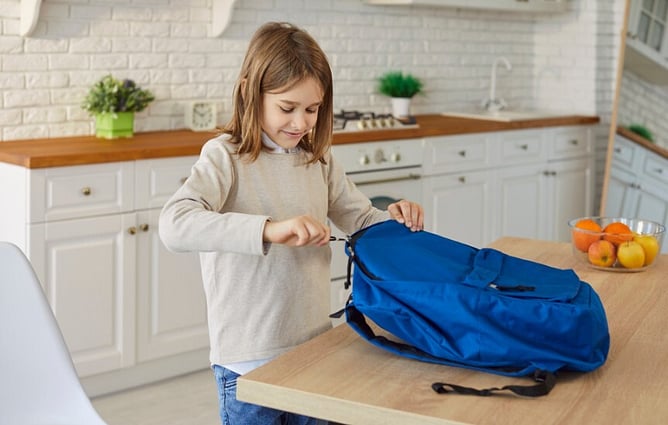
When a child follows a visible morning routine, checks a chore chart, tracks their homework, breaks down a school project or packs their own bag, they are strengthening neural pathways responsible for planning and self-management. The environment acts as scaffolding — a temporary support that helps the brain practise until the skill becomes internal.
Using a family wall planner can serve as that scaffold. Over time, what begins as “checking the board” becomes “remembering independently.” That is how executive function strengthens.
What Executive Function Looks Like in Everyday Family Life
Executive function can sound theoretical, but in daily family life it looks very practical.
It looks like a child remembering to bring their lunchbox inside after school instead of leaving it in the bottom of their bag for three days. It looks like a Year 6 student checking when their maths test is scheduled rather than being surprised on the day. It looks like a teenager laying out their uniform the night before or packing sports gear ahead of tournament day.
These are not personality traits. They are cognitive skills in action.
When children forget repeatedly, it is rarely a character flaw. It is often a working memory limitation. When a teenager leaves an assignment until the night before, it is not necessarily laziness. It may be difficulty with task initiation or time projection — both core components of executive function.
Visible structure compensates for those developing systems. A family wall planner or homework planner NZ students engage with daily provides environmental support while the brain catches up. Instead of relying on fragile internal memory, children rely on visible cues.
Over time, that repetition strengthens internal organisation. The scaffold slowly becomes unnecessary because the skill has been practised enough to stabilise.
That is brain development in motion.
Chores Strengthen Working Memory and Self-Control
Research supports what many parents intuitively sense. A study published in the Wiley Online Library found:
“Certain chores predicted children’s working memory and inhibitory control.”
https://onlinelibrary.wiley.com
Working memory allows children to hold information in mind while completing tasks. Inhibitory control allows them to resist distractions and persist when something feels difficult. These skills are foundational for academic achievement and emotional regulation.
An age-appropriate chore chart that families use consistently is therefore not simply about sharing housework. It strengthens task persistence, follow-through, self-discipline and delayed gratification. When children repeatedly complete responsibilities without prompting, they practise sustaining attention and managing impulses.
Repeated responsibility builds capacity.
Over time, that capacity becomes character.
Responsibility also strengthens emotional regulation. Completing chores teaches frustration tolerance — the ability to continue even when something feels boring or mildly uncomfortable.
That skill matters hugely during adolescence.
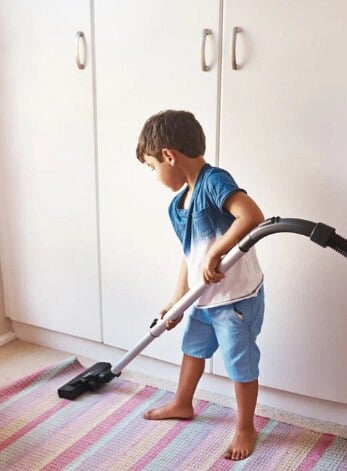
Responsibility Builds Emotional Regulation
Cognitive growth is only part of the picture. Responsibility also strengthens emotional regulation.
When children complete chores consistently, they practise tolerating mild discomfort. They practise finishing something that may not feel immediately rewarding. They practise managing the impulse to avoid effort.
Those small acts of follow-through build frustration tolerance — the ability to stay regulated when something feels boring, repetitive or inconvenient.
This matters deeply in adolescence.
Teenagers who have grown up completing predictable responsibilities are more accustomed to delayed gratification. They are less shocked by effort. They are more familiar with the feeling of finishing something they did not initially want to start.
That familiarity builds resilience.
Responsibility teaches children that discomfort is temporary, effort is manageable and completion feels satisfying.
Those lessons compound.
Routine and Responsibility Build Confidence — Not Just Compliance
There is a meaningful difference between “Do it because I said so” and “This is what needs doing.”
When expectations live only in a parent’s voice, responsibility feels external and imposed. When expectations are visible within a shared system, responsibility feels predictable and collective.
Children can see what is required. They can act without prompting. They can experience completion. They can feel trusted.
Each completed task reinforces self-efficacy — the belief “I am capable.”
Research on self-efficacy in educational psychology consistently demonstrates that children who believe they are capable are more likely to persist in difficult tasks and achieve stronger academic outcomes.
Responsibility shapes identity. Children begin to see themselves as contributors to family life rather than passengers being managed.
That identity shift is far more powerful than short-term compliance.
Clear Routines Reduce Daily Conflict
Most family tension happens during transitions: getting out the door, homework time, screen-time limits and bedtime. Transitions require planning and self-regulation, which are still developing skills.
Ambiguity creates friction. Visible routines reduce ambiguity.
When mornings follow a predictable sequence — making the bed, brushing teeth, packing the school bag, checking the planner — children know what to expect. After school, unpacking bags, completing homework, preparing gear and reviewing the next day creates structure. Evenings that include laying out uniforms and packing lunches reduce the morning rush.
The power lies in consistency, not complexity.
Instead of repeatedly asking, “Have you done this yet?” parents can ask, “What’s next on the board?” Responsibility becomes externalised. The system carries the expectation, which reduces emotional friction between parent and child.
Conflict decreases because the structure speaks.
Responsibility Strengthens Organisation and Time Management
A homework planner that families use daily does more than track assignments. It teaches children how to prioritise tasks, estimate how long something will take, break complex projects into manageable stages and plan backwards from deadlines.
When a school project is mapped across several weeks — research, planning, drafting and submission — children learn that large tasks become manageable when broken down. Instead of reacting to deadlines, they learn to anticipate them.
Planning reduces stress because it removes surprise. Structure reduces overwhelm because effort is distributed across time. These skills compound over years, strengthening independence.
The Transition to Secondary School: Where Structure Pays Off
One of the biggest pressure points for families in Aotearoa is the move from Intermediate to Secondary School.
In Primary settings, teachers often provide reminders and structured oversight. In Secondary school, students suddenly manage multiple teachers, rotating timetables, overlapping assignments and increased extracurricular demands.
The organisational load increases sharply.
Students who have already practised writing deadlines down, breaking projects into stages and reviewing a planner daily adapt far more smoothly. The shift feels challenging but manageable.
Students who have not had visible scaffolding often experience a steep learning curve. Parents may suddenly feel as though they are chasing assignments, checking portals and firefighting deadlines late at night.
The difference is not intelligence. It is preparation.
Responsibility practised in Year 3 and Year 6 quietly supports competence in Year 9 and Year 11.
Visible planning systems reduce that shock because they make complexity predictable.

Responsibility Must Be Taught Explicitly — Not Assumed
Many parents assume responsibility will “click” as children get older. But executive function does not suddenly switch on in adolescence.
Children are not born knowing how to plan backwards from a deadline, estimate homework duration, balance sport and school or anticipate tomorrow’s needs. These are learned behaviours.
If scaffolding is absent in Primary and Intermediate years, teenagers can suddenly find themselves expected to manage NCEA assessments without established planning habits. What appears as procrastination or disorganisation is often a skills gap.
A visible homework planner that students interact with daily helps them practise anticipating workload, breaking tasks into stages and monitoring progress. This process, known as metacognition — thinking about thinking — is strongly linked to academic success.
Responsibility builds gradually when it is visible and repeated.
The Stress Response and the “Last-Minute Panic” Pattern
Many households recognise the familiar cycle: a deadline approaches, a child forgets, a parent discovers the issue late in the evening, tension rises and stress escalates.
This pattern is rarely about defiance. It is about planning gaps.
When the brain perceives surprise urgency, it activates a stress response. Stress reduces working memory capacity, making organisation harder in the very moment it is needed most.
Visible systems interrupt that pattern. When assignments and commitments are written publicly, deadlines are not surprises. Work can be distributed across days. Effort becomes predictable. Stress remains manageable.
A family Planning Panel shifts the emotional curve from spike to steady. Planning is preventative stress management.
The Mental Load Conversation in New Zealand Households
Mental load is increasingly discussed in New Zealand, particularly among working mothers balancing paid employment and unpaid coordination.
The Ministry for Women’s time-use data confirms what many families already feel: women carry a disproportionate share of unpaid labour. But beyond physical tasks, it is the cognitive planning that exhausts many parents — the remembering, anticipating and tracking. You can read more about this here: https://www.women.govt.nz
When planning is invisible, it is easy for other family members to underestimate its weight.
When planning is visible, it becomes shared knowledge.
A Planning Panel that households use daily makes the week transparent. It makes appointments, commitments and deadlines visible to everyone. That visibility invites contribution.
Children can check what is coming. Partners can anticipate what needs preparing. Responsibility becomes a shared landscape rather than a private burden.
This is not about perfection. It is about partnership.
And partnership protects wellbeing.
Long-Term Outcomes: What the Research Suggests
Longitudinal research shows that children involved in age-appropriate household responsibilities are more likely to demonstrate conscientiousness, independence, problem-solving capacity and stronger emotional wellbeing.
Conscientiousness — the tendency to be organised, reliable and disciplined — strongly predicts academic achievement, career stability, financial responsibility and long-term health behaviours.
These traits are cultivated through repeated, structured responsibility.
When children grow up in homes where expectations are visible and contribution is normalised, responsibility becomes part of identity. Identity shapes behaviour. Behaviour shapes trajectory.
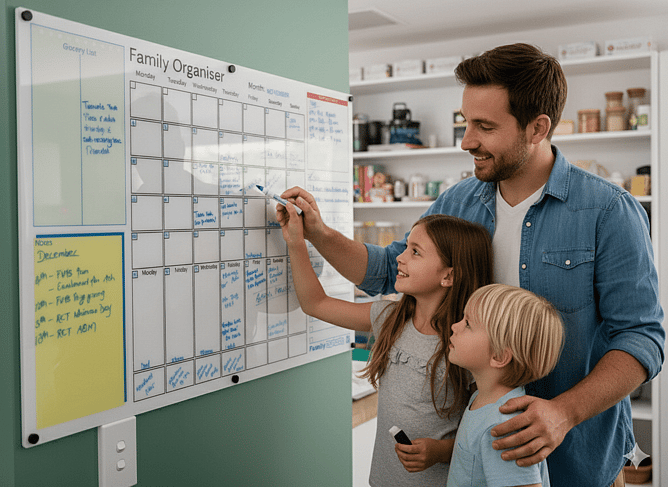
School Organisation Without the 9pm Panic
School life includes far more than homework. Sports fixtures, camps, mufti days, book week, cultural festivals, parent-teacher evenings and assignment deadlines all compete for attention.
Without a system, everything feels urgent.
A monthly overview combined with weekly tracking allows families to anticipate busy periods, avoid clashes and prepare in advance. When events are written publicly, everyone can see them. Everyone can prepare for them.
The panic reduces.
The Cumulative Effect of Small Daily Responsibility
Responsibility is not built through lectures. It is built through repetition.
A single week of visible routines will not transform a child’s identity. But years of predictable responsibility will.
When children repeatedly check a planner, complete chores, prepare for commitments and anticipate deadlines, they internalise a pattern:
I look ahead.
I prepare.
I follow through.
That pattern becomes automatic.
By the time they reach senior secondary years, those habits support NCEA tracking, exam preparation, part-time work commitments and independent scheduling.
Responsibility becomes self-concept.
And self-concept shapes adulthood.
The goal is not perfectly organised children.
The goal is capable, confident adults who know how to manage their lives.
In Closing
Responsibility is not taught through pressure. It is taught through structure.
When expectations are visible, children feel capable. Parents feel supported. Homes feel calmer.
Responsibility strengthens executive function. Executive function strengthens independence. Independence builds confident adults.
And visibility makes it possible.
If you’re looking for the best family organiser board in New Zealand — one designed for real Kiwi homes, built for visibility and daily use — FamilySpaces offers durable, professional Planning Panels created to reduce mental load and build responsibility.
Start with visibility, because clarity changes everything.
Explore our New Zealand-designed Planning Panels and find the right fit for your whānau.