
A Practical Guide for Busy Kiwi Mums and Whānau
The New Zealand school year does not arrive quietly.
It begins with new teachers, new emails, new sport registrations, new expectations and a sudden return to alarms, uniforms and packed lunches. One week you are still operating in holiday rhythm. The next, you are standing in the kitchen at 7:43am looking for a missing shoe while mentally drafting a reply to a school notice you read at 10:12pm the night before.
At work, you operate inside systems. There are shared calendars, visible workflows and clear accountability. At home during the school term, it can feel like you are the system. You are the one holding the mental map — swimming days, sport draws, camp payments, lunchbox supplies, emotional temperature checks and the quiet awareness of what is coming next.
If you feel capable in one environment and constantly behind in the other, that is not a personal flaw. It is a structural load.
The pressure of the New Zealand school year is not random chaos. It is predictable intensity without visible infrastructure.
Key Takeaways
The NZ school year moves in predictable pressure waves across four terms.
Research across New Zealand and Australia shows women still carry the majority of school-related planning and coordination.
Burnout builds through micro-decisions and invisible labour.
Visibility reduces cognitive overload (mental strain from too many decisions).
One central planning system homes can rely on to help distribute responsibility more evenly.
A family organiser board New Zealand families use daily can act as practical infrastructure — not decoration.
The Mental Load of the School Year Is Structural, Not Personal
When the school year feels overwhelming, many mums assume the problem is personal. They tell themselves they should be more organised. More disciplined. Better at keeping on top of things.
But the data tells a different story.
Across Australia, the Australian Institute of Family Studies reports:
“Mothers are more likely than fathers to take primary responsibility for organising children’s activities and managing family schedules.”
https://aifs.gov.au
In Aotearoa, Stats NZ’s Time Use Survey confirms the same pattern, noting that:
“Women continue to undertake a greater share of unpaid work, including childcare and household management.”
https://www.stats.govt.nz
On paper, those findings may sound neutral. But lived experience makes them tangible.
“Household management” is not simply cleaning or cooking. It is the invisible administration of family life. It is reading every school email before anyone else has opened it. It is noticing that the uniform is tight before the child complains. It is tracking sport fees and remembering that swimming starts in Week 4. It is anticipating mufti days, teacher-only days, early finishes and overlapping commitments.
It is being the default anticipator.
This is cognitive labour — the ongoing mental work of planning, anticipating and monitoring that often goes unseen. Unlike a pile of laundry, it leaves no visible evidence. There is no finished product to point to. It simply exists in the background, running constantly.
Cognitive labour does not feel dramatic.
It accumulates.
It shows up as waking at 3am remembering a form. It shows up as scanning the fridge while mentally calculating dinner options. It shows up as carrying three weeks of upcoming commitments in your head at once.
When one person carries the invisible planning system of the home, exhaustion builds quietly. Not because she lacks capability. Not because she is disorganised. But because she is functioning as infrastructure without structural support.
And infrastructure is not meant to be held by one nervous system.
When planning lives privately inside one person’s mind, it is easy for others to underestimate its weight. They see the outcome — the child arrives at sport on time, the uniform is clean, the notice is signed — but not the mental coordination that made it happen.
That invisibility can create isolation.
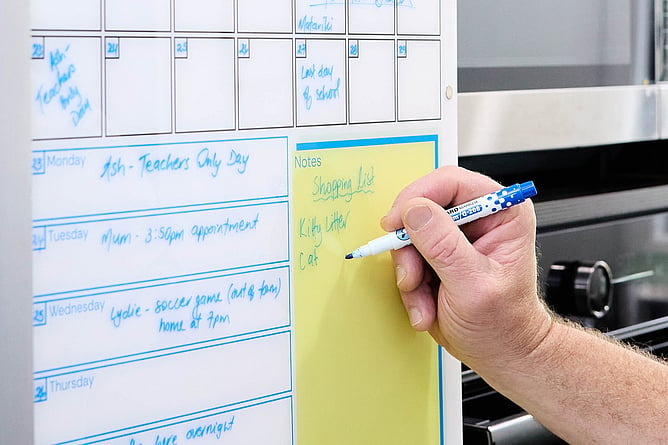
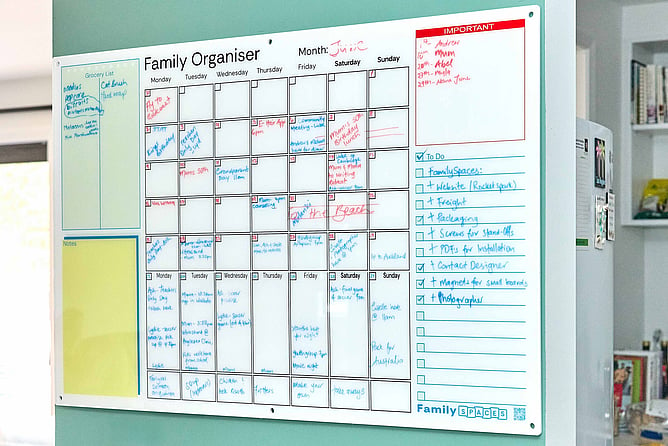
But when planning becomes visible — written on a family wall planner, mounted centrally, referenced daily — the structure shifts. The mental map moves from private to shared. The week becomes collective knowledge rather than individual burden.
The load does not disappear overnight.
But it becomes visible.
And visible systems are easier to distribute than invisible ones.
Burnout Builds Through Micro-Decisions
Burnout rarely begins with one catastrophic Monday morning.
It builds quietly through hundreds of small, repetitive decisions made every single day.
Do we have bread?
Whose turn is it to do pickup?
Is sport cancelled because of rain?
Did I reply to that email?
What is for dinner?
Has the uniform dried?
Did everyone pack their PE gear?
Individually, none of these questions feel dramatic. They are ordinary. Manageable. Even mundane.
But cumulatively, they require attention.
And attention is not unlimited.
Psychologist Roy Baumeister’s research on decision fatigue has demonstrated that the act of making decisions draws from the same cognitive energy used for self-control. As summarised by the American Psychological Association:
“Making decisions uses the very same mental energy that we use for self-control.”
https://www.apa.org
This means every small choice — even low-stakes ones — draws from the same mental reservoir you rely on to stay patient, regulate emotion and respond thoughtfully under pressure.
By Wednesday evening, it is not that you lack resilience.
It is that your cognitive energy has been spent.
Decision fatigue (the gradual deterioration in the quality of decisions after a long session of decision-making) narrows focus. It reduces tolerance. It makes simple problems feel heavier. It shortens emotional runway.
In family life, this can look like snapping over something small. Feeling overwhelmed by a minor disruption. Struggling to think clearly when another notice arrives. Losing patience at 8:12pm when someone mentions a project due tomorrow.
The exhaustion is not weakness.
It is depletion.
And what makes it particularly draining is that many of these decisions do not need to be made in the moment. They recur weekly. Predictably. Repeatedly.
When dinner is decided in advance, that question disappears at 5:17pm.
When pickup duties are written down, no one has to renegotiate them mid-afternoon.
When sport cancellations are noted on a shared planner, you are not scanning three group chats while stirring pasta.
Externalising decisions protects cognitive energy.
A visible family planning system in the home acts as a decision filter. It moves predictable choices out of reactive space and into proactive space.
You do not need stronger willpower.
You need fewer invisible decisions competing for attention.
When the system carries part of the load, your mental battery lasts longer.
And when your mental battery lasts longer, everything else feels steadier.
The New Zealand School Year Has a Predictable Rhythm
The school year in Aotearoa does not move in a straight line.
It moves in waves.
When we forget that, we interpret every spike in pressure as personal failure. But when we step back and look at the pattern, something steadier emerges.
Term 1 is adjustment. It carries administrative weight. New teachers, new class dynamics, swimming blocks, sport registrations, camps, permission slips and the quiet effort of re-establishing routine after summer freedom. Even children who appear excited are expending emotional energy adapting to new expectations. Parents are learning new communication rhythms, new drop-off procedures and new calendars. Everything feels front-loaded because it is.
Term 2 shifts the pressure rather than reducing it. Winter sport begins in earnest. Mornings are darker and colder. Wet uniforms take longer to dry. Illness moves through classrooms and households in steady waves. The novelty of the new school year has faded, but the commitments remain. Energy feels heavier because the initial motivation has settled into routine.
Term 3 often carries a quieter kind of strain. Fatigue accumulates. Motivation dips. Assignments feel more demanding. Teenagers, in particular, may experience a mid-year slump as academic expectations rise. Even well-organised households notice the stretch. It is not chaos — it is cumulative effort.
Term 4 compresses everything. Assessments, exams, prizegivings, performances, end-of-year events and Christmas build-up all compete for attention. The calendar tightens. Financial pressure often increases. Emotional intensity rises as the year closes.
When you recognise that intensity is seasonal rather than evidence that you “can’t keep up,” something shifts internally. You stop asking, “Why does this always feel so hard?” and start asking, “What does this term require?”
Different seasons require different levels of margin.
Term 1 may require more administrative visibility. Term 2 may require lower expectations around extracurricular extras. Term 3 may require more rest. Term 4 may require deliberate simplification.
Preparation is not about eliminating busy terms. It is about anticipating them so they do not catch you off guard.
A visible planning system — like the Planning Panel, that families can use to map the week in one central place — supports this seasonal awareness. When the rhythm of the term is written down and visible — camps in Week 5, sport finals in Week 9, assessments due across multiple weeks — pressure becomes predictable. And predictable pressure is easier to navigate than unexpected spikes.
The school year does not need to feel like a constant uphill sprint.
It has a rhythm.
And when you plan with the rhythm instead of against it, steadiness replaces self-blame.
Visibility Reduces Cognitive Overload
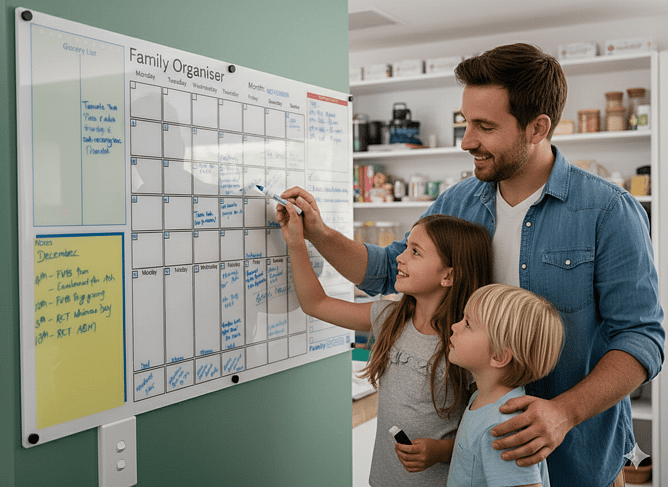
When commitments live only in your head, they grow.
They do not sit neatly in a mental corner waiting to be recalled. They float. They compete for attention. They resurface at inconvenient moments — while driving, while trying to fall asleep, while standing in the supermarket wondering whether you remembered everything.
Cognitive overload (mental strain caused by too much information competing for limited working memory) does not require dramatic chaos. It builds when the brain is forced to hold and rehearse multiple future tasks at once.
Behavioural scientist Wendy Wood explains:
“Much of everyday behaviour is driven by cues in our environment rather than conscious decisions.”
https://wendywood.com
The brain is constantly scanning for external signals to reduce internal effort. When cues are visible, behaviour becomes more automatic. When cues are absent, the brain must work harder to remember and initiate action.
This is why visibility matters.
A visible cue reduces the need for internal recall. Instead of remembering, you refer. Instead of mentally carrying the week, you externalise it. The information leaves your working memory and sits somewhere stable.
That shift is not cosmetic. It is neurological.
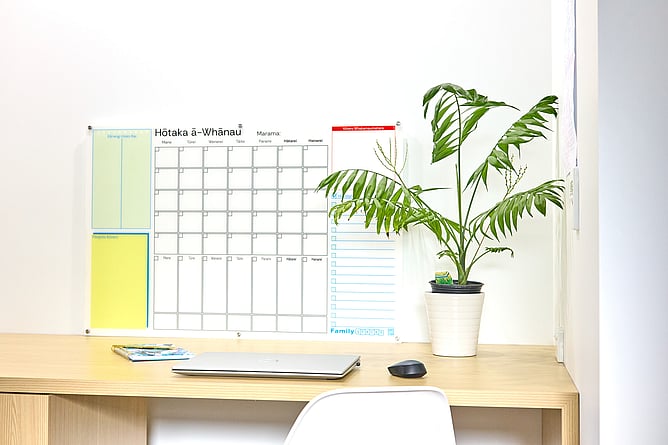
When a Planning Panel is mounted in a central space — kitchen wall, hallway, family hub — it becomes environmental scaffolding (a temporary support that helps skills develop until they become internal). Children can see what is coming without asking. Partners can anticipate responsibilities without being prompted. The week becomes shared information rather than private knowledge.
Repeated reminders slowly transform into shared reference.
Instead of “Have you packed your bag?” the conversation becomes, “What does the planner say tomorrow looks like?” Instead of scanning three group chats to confirm sport times, you glance at the wall.
Digital calendars are useful tools for adults, particularly for coordinating work commitments. But they live inside phones. They require intentional checking. They are invisible to children walking past the fridge.
A visible family planning system brings the week into shared physical space. It creates ambient awareness. Even when no one is actively discussing it, the information is present.
That presence reduces mental rehearsal. It reduces repeated questioning. It reduces the sense that everything is being held in one person’s mind.
At FamilySpaces, we design Planning Panels specifically for real households — overlapping sport draws, shift work, shared parenting arrangements, community commitments and the unpredictability of everyday life. As a New Zealand family organiser board company, the focus is not on aesthetics alone but on durability and daily usability. Systems only work when they are used consistently. And consistency depends on visibility.
When the week is visible, it stabilises.
And when it stabilises, the nervous system follows.
Plan One Week at a Time
One of the fastest ways to overwhelm yourself during the school year is to hold the entire term in your head.
Ten weeks of sport draws, assessments, swimming blocks, appointments and social commitments can blur together until everything feels urgent. When the horizon stretches too far, the brain struggles to prioritise. Cognitive overload increases because you are trying to mentally rehearse too many future scenarios at once.
Instead of thinking in terms, reduce the horizon.
Bring it back to one week.
Psychologist Peter Gollwitzer’s research on implementation intentions — the practice of specifying when and where a task will happen — shows that concrete planning significantly increases follow-through and reduces cognitive strain. As he explains:
“Goal intentions alone are often not sufficient to prompt goal-directed actions. However, forming implementation intentions that specify the when, where, and how of goal striving increases the likelihood that goal-directed behaviours will be performed.”
Gollwitzer, P. M. (1999). Implementation intentions: Strong effects of simple plans. American Psychologist.
https://doi.org/10.1037/0003-066X.54.7.493
In simple terms, vague intention (“We’ll sort dinner out during the week”) creates ongoing mental noise. Specific planning (“Tuesday is pasta; Thursday is leftovers; sport pickup is confirmed”) closes cognitive loops.
Planning seven days is neurologically easier than planning seventy.
A weekly reset — often on a Sunday afternoon or evening — acts as a pressure release valve. It creates a contained window where you look ahead deliberately rather than reactively. Instead of discovering obligations midweek, you meet them on your own terms.
Mapping one week does not require perfection. It requires clarity.
Write dinners down so that 5:17pm does not become a daily negotiation. Clarify pickup duties so that no one is texting in confusion at 3:04pm. Reset school bags so stray notices and half-finished forms do not ambush you mid-morning. Check uniforms before the rush. Note upcoming commitments so nothing feels like it appeared from nowhere.
Research on stress and predictability consistently shows that uncertainty amplifies anxiety, while structured anticipation reduces it. When the brain can see what is coming, it does not activate the same urgency response as it does when faced with surprise demands.
This is not about controlling every variable.
It is about reducing avoidable friction.
Small preparation creates breathing space. And breathing space protects patience.
Patience rarely disappears because we are incapable.
It disappears because we are overloaded.
The school term may be ten weeks long.
But you only ever need to manage the next seven days.
And when those seven days are clear, the rest feels less intimidating.
Emotional Load Is Part of the School Year
The school year is not purely logistical.
It is easy to focus on uniforms, notices, sport registrations and packed lunches because those are visible tasks. But beneath the surface, every school term carries emotional undercurrents that are just as demanding.
Friendships shift. Class dynamics change. Academic expectations increase. Social comparison intensifies — especially as children move into Intermediate and secondary school. Fatigue builds as the weeks stretch on. Identity formation accelerates, particularly in adolescence, when belonging can feel fragile and deeply personal.
These pressures rarely arrive announced.
They show up as subtle changes.
A child who suddenly does not want to go to training.
A teenager who snaps over something small.
A quiet withdrawal after school.
A surge of anxiety before a presentation or assessment.
When we view the school year only through a planning lens, we miss this parallel emotional current. And when emotional load combines with logistical load, the home can feel heavier than it needs to.
Research consistently shows that children’s stress levels are influenced by the emotional climate of their home. When adults are operating at the edge of capacity — mentally stretched, time-poor and decision-fatigued — emotional regulation becomes harder for everyone.
That is why emotional scaffolding matters.
Emotional scaffolding (structured support that helps a child process feelings until they can manage independently) does not require long therapy-style conversations. It often begins with regular, low-pressure check-ins.
“What are you looking forward to this week?”
“What feels tricky?”
“What would make tomorrow easier?”
These questions do two things.
First, they signal safety. They tell a child that emotions are expected, not inconvenient. Second, they surface small concerns before they grow into bigger reactions.
Five minutes of connection on a Sunday evening can prevent thirty minutes of escalation on a Wednesday morning.
When children feel seen before pressure peaks, transitions soften. Mornings feel less combative. Homework sessions feel less tense. The emotional temperature of the household stabilises.
And here is where systems quietly support emotional wellbeing.
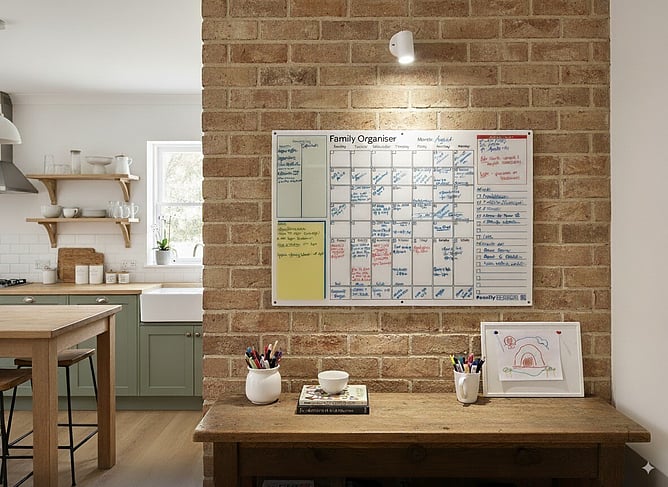
When the week is visible on a Planning Panel — when assessments, sport commitments and social events are written down — emotional stress loses some of its unpredictability. A child can see that a busy week is coming. They can anticipate it. They can prepare mentally.
Instead of feeling ambushed by a speech they forgot about, they can see it approaching. Instead of reacting to a surprise double-booked afternoon, they can anticipate the squeeze.
Calmer mornings do not begin with tighter control.
They begin with steadier systems that reduce surprise.
When logistics are stable, emotional capacity increases.
And when emotional capacity increases, the whole whānau feels it.
Financial Pressure Compounds School Stress
The New Zealand school year does not run in isolation from the wider realities of family life. It overlaps with rising grocery prices, fluctuating petrol costs, winter power bills, sport registrations, uniform replacements and the steady rhythm of growing children who seem to outgrow shoes overnight.
On paper, many of these costs are predictable. Swimming blocks happen every year. Winter sport sign-ups return. Camps sit in roughly the same term. Yet what often creates stress is not the existence of the cost — it is the timing and the surprise.
Te Ara Ahunga Ora – Commission for Financial Capability notes:
“Financial stress remains one of the leading causes of anxiety for New Zealand households.”
https://www.cffc.org.nz
Financial stress does not only affect bank balances. It affects nervous systems. When money pressure combines with time pressure, the body responds as if facing threat. Cortisol rises. Patience lowers. Small disruptions feel bigger than they are.
Research in family wellbeing consistently shows that parental stress spills into the emotional climate of the home. When adults operate in a constant state of low-level financial vigilance — mentally calculating, anticipating shortfalls, juggling timing — their cognitive bandwidth shrinks. Decision-making becomes harder. Emotional regulation becomes thinner. The school year then feels heavier than it objectively is.
What intensifies the stress is surprise.
A camp notice discovered the night before it is due.
A sport fee forgotten until registration closes.
A uniform that no longer fits two days before term starts.
Surprise compresses time. And when time compresses, pressure multiplies.
Visible planning systems interrupt that compression.
When key school dates are written down weeks ahead, the financial rhythm of the term becomes visible. You can see that swimming and winter sport overlap. You can anticipate that Term 4 always carries higher costs. You can spread preparation across weeks instead of reacting in one stressful moment.
Preparation does not eliminate expense.
But it restores agency.
When costs are visible, they become part of a wider pattern rather than isolated shocks. The nervous system stays steadier because nothing feels like an emergency.
There is also a long-term modelling effect happening quietly in the background.
Children learn how to handle pressure by watching how adults respond to it. When school costs trigger panic or tension, they internalise that stress. When school costs are anticipated and calmly discussed — “Camp is coming up in three weeks, so we’ll prepare for that” — they absorb a different lesson.
They learn that planning precedes spending.
They learn that preparation reduces pressure.
They learn that stress can be managed through visibility rather than avoidance.
A visible family wall planner in the home becomes more than an organisational tool. It becomes a modelling tool. It shows children that school life — including its financial rhythms — is predictable, navigable and manageable.
Clarity does not remove cost.
But it reduces urgency.
And reduced urgency protects parental wellbeing — which, in turn, protects the emotional climate of the entire whānau.
Time Pressure and Wellbeing
Financial pressure is visible. Time pressure is quieter — but just as corrosive.
The New Zealand school year compresses afternoons and evenings into narrow windows. Work finishes at five. Sport starts at five-thirty. Dinner still needs cooking. Homework needs checking. Notices need signing. Lunchboxes need packing. By the time everyone sits down, it is nearly bedtime.
The problem is not that families are disorganised. The problem is that the margin has disappeared.
When time feels scarce, the nervous system responds similarly to financial threat. There is a subtle but constant sense of urgency. Conversations shorten. Patience thins. Small disruptions feel disproportionate because there is no buffer to absorb them.
Research into time scarcity shows that when people perceive they have insufficient time, their cognitive bandwidth narrows. Focus becomes reactive rather than strategic. Decision-making becomes short-term rather than thoughtful. In family life, that can look like snapping instead of explaining, rushing instead of connecting, reacting instead of preparing.
The New Zealand school year amplifies this because commitments stack in predictable clusters. Sport seasons overlap with assessment deadlines. Winter illness overlaps with darker mornings. Term 4 compresses exams, performances, prizegivings and end-of-year expectations into the same few weeks.
Without visibility, time pressure feels chaotic.
With visibility, it becomes structured.
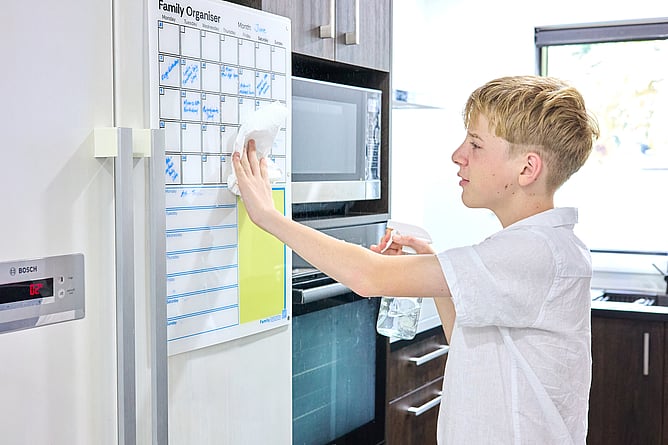
A family planning system in the home does more than track events. It restores margin by making the week realistic. When you can see that Tuesday carries two pickups and a late meeting, dinner can be simplified intentionally. When you can see that Thursday is heavy with commitments, you can lower expectations elsewhere.
Visibility creates strategic adjustment.
Instead of being surprised by exhaustion, you anticipate it. Instead of assuming every week should operate at full capacity, you respond to the rhythm of the term.
There is also an important modelling layer here.
When children observe adults anticipating busy weeks and adjusting expectations accordingly, they learn that pressure can be managed through planning. They see that intensity is temporary. They see that rest and preparation are deliberate choices, not signs of weakness.
Time pressure does not disappear.
But when the week is visible, urgency softens.
And softened urgency protects wellbeing.
Infrastructure Protects Energy
Many busy mums quietly tell themselves the same story at the end of a hard term: next term I just need to be more organised. I’ll try harder. I’ll wake earlier. I’ll stay on top of it better.
The assumption is that the solution lives in personal discipline.
But motivation fluctuates. Energy fluctuates. Life fluctuates.
Infrastructure remains.
At work, you do not rely on memory and good intentions alone. You rely on shared calendars, visible schedules, defined roles and documented processes. You do not expect one person to carry every moving part silently in their head. Systems exist precisely because human capacity is limited.
Home deserves the same respect.
When the organisation of family life depends solely on one person remembering everything, that person becomes the infrastructure. And human nervous systems are not designed to function as permanent administrative hubs.
A visible planning system — like the Planning Panel many families use daily — shifts the load from internal memory to external structure. It reduces repeated conversations because information is already accessible. It reduces micro-decisions because predictable choices have been made in advance. It distributes awareness because everyone can see the same week at the same time.
This is not about aesthetics.
It is about cognitive energy.
When the week is mounted visibly in a shared space, children see what is coming. Partners see what needs preparing. Responsibility becomes clearer without constant verbal prompting.
Clarity reduces friction.
Friction is what drains energy — the repeated clarifying, reminding, negotiating and reacting that happens when information is invisible.
When friction reduces, energy stabilises.
And when energy stabilises, patience returns more easily. Mornings soften. Evenings feel less brittle. The school year still carries intensity, but it no longer rests on one person’s shoulders alone.
Infrastructure does not remove effort.
It ensures effort is sustainable.
In Closing
The New Zealand school year is not light.
It was never designed to be.
It carries academic expectations, sport commitments, social shifts, financial pressure and the steady work of growing children who are learning who they are in real time. Some weeks feel smooth. Others feel relentless. That fluctuation is not a personal failing — it is the rhythm of the year.
Term by term. Wave by wave.
You cannot eliminate busy seasons. They are woven into the calendar. But you can change how those seasons land in your home.
When commitments are visible rather than floating in one person’s head, pressure softens. When the week is mapped clearly, surprise reduces. When responsibility is shared rather than silently absorbed, energy lasts longer.
Planning one week at a time does not make life perfect. It makes it predictable. And predictability steadies the nervous system. It protects patience. It lowers the emotional temperature on hard mornings. It turns reactive scrambling into deliberate preparation.
You were never meant to function as the invisible operating system of your household.
When the system supports your whānau, you stop being the system.
And that shift — from carrying everything internally to sharing it visibly — changes the emotional climate of your home in ways that compound across the year.
Not because life becomes easier.
But because it becomes steadier.
If the school year feels heavier than it needs to, the answer is not to try harder.
It is to make it visible.
That visibility can start small. Our free Home Life Toolkit offers practical guidance around calmer mornings, meal planning and budgeting — simple systems that reduce daily decision fatigue and help you approach the week with intention rather than reaction. Even one consistent weekly reset can shift the tone of a term.
And when that weekly clarity is anchored somewhere visible, everything steadies.
A Planning Panel mounted in a central space becomes more than a calendar. It becomes shared awareness. It becomes reference instead of reminder. It becomes the quiet structure that holds the week steady so one person no longer has to.
When the rhythm of the term is written down, when responsibilities are clear, when everyone can see what is coming next, the pressure shifts from reactive to prepared.
That is not about perfection.
It is about sustainability.
Explore our New Zealand-designed Planning Panels and find the right fit for your whānau.
Because surviving the school year is not about doing more.
It is about building systems that help everyone carry it together.