A Practical Guide for Overwhelmed Mums Who Need More Than a Calendar
There is a particular kind of exhaustion that does not come from physical labour.
It comes from holding the map.
It is 7:38am. Someone cannot find their shoes. Someone else casually announces they need a gold coin donation today. You are mentally calculating whether the automatic payment will clear tomorrow, whether there is enough milk for breakfast, and whether you replied to that school email before midnight.
Everyone else moves through the morning.
You are coordinating it.
And somewhere in that half-second pause between buttering toast and locating a missing hoodie, you think:
“How am I the only one holding all of this?”
You are not imagining it.
Across Aotearoa, dual-income households are now common for families with dependent children. Stats NZ notes:
“In households with dependent children, most have two employed parents.”
— Stats NZ, Household Labour Force Survey
https://www.stats.govt.nz/indicators/employment-rate/
Life is full. Kura. Sport. Kapa haka. Youth group. Sleepovers. Birthday parties. Grocery shops. Power bills. Appointments.
It is rich. It is beautiful. It is relentless.
And while everyone benefits from a smoothly running household, it is often one person — usually mum — who carries the invisible coordination.
The remembering.
The anticipating.
The tracking.
The quiet, constant mental rehearsal of what is coming next.
A well-designed family organiser board in New Zealand homes does not remove busyness.
But it fundamentally changes how that busyness is experienced.
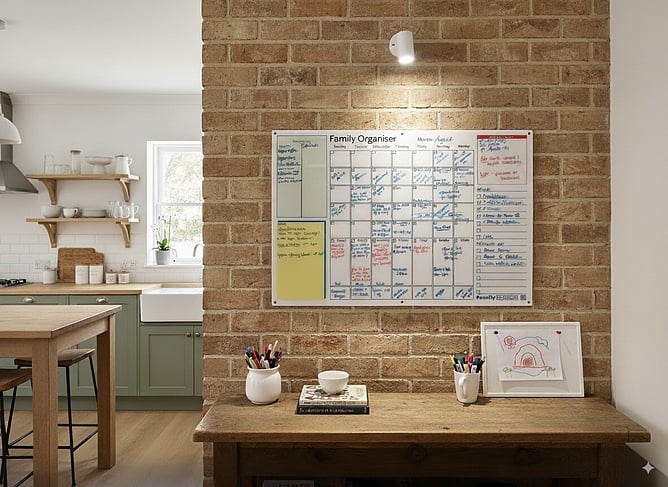
At FamilySpaces, we call our organiser boards Planning Panels — because they are not simply whiteboards. They are structured planning systems designed for real Kiwi whānau, where life is layered and schedules overlap.
Before we look at size, materials or layout, we need to talk about why visibility changes everything.
Key Takeaways
If you’re reading this between school pick-up and dinner prep, here’s the heart of it:
Visibility reduces mental load and distributes responsibility.
Shared wall planning changes family dynamics.
Size matters — 900mm x 600mm Premium vs 600mm x 430mm A2 Compact.
Structured layouts reduce weekly decision fatigue.
Layered acrylic construction ensures long-term durability and clarity.
Available in both English and Te Reo Māori, designed for Aotearoa homes.
Supports meal planning, budgeting and everyday organisation.
A reusable Planning Panel is an investment in calmer routines — not just a board.
Now let’s unpack that properly.
The Invisible Work That No One Sees
For years, I kept everything in my head.
Not because I wanted to.
Because that’s just how it evolved.
School dates.
Swimming lessons.
Sport practices.
Birthday presents.
Dentist reminders.
Meal plans.
Which account the power bill comes from.
It wasn’t dramatic.
It was just constant.
Research confirms what many women already feel.
Sociologist Allison Daminger explains:
“Women not only do more housework, they are more likely to take responsibility for anticipating needs, identifying options and monitoring outcomes.”
— Daminger, A. (2019). American Sociological Review
https://doi.org/10.1177/0003122419859007
Stats NZ’s Time Use Survey reinforces the imbalance:
“Women spend more time than men on unpaid work activities.”
— Stats NZ
https://www.stats.govt.nz/indicators/time-use/
But research doesn’t fully capture the subtle strain.
The feeling of being the default reminder system.
The one who notices when something’s about to fall through the cracks.
The one who carries the “what’s next” list at 2am.
When planning lives in one person’s head, it becomes invisible labour.
And invisible labour rarely feels evenly shared — even when effort is recognised.
That’s where a visible planning system changes things.
Not because it removes tasks.
But because it removes invisibility.For years, many of us kept everything in our heads.
Not because we preferred it that way. Not because we believed it was efficient. But because, slowly and almost imperceptibly, it became the path of least resistance. One person reads the school email first. One person remembers swimming starts in Week 4. One person notices the uniform is getting tight before anyone else realises. One person tracks which account the power bill comes from and whether that automatic payment will clear in time.
Over time, that person becomes the holder of the map.
Swimming days.
Sport practices.
Camp payments.
Dentist reminders.
Meal planning.
Grocery top-ups.
Whose birthday is coming up.
Which afternoon is double-booked three weeks from now.
None of these tasks are dramatic in isolation. There is no single moment that feels overwhelming enough to justify the weight of it. The strain does not arrive as crisis. It accumulates as continuity. It builds through repetition.
Sociologist Allison Daminger describes this pattern with striking clarity in her research on household labour:
“Women not only do more housework, they are more likely to take responsibility for anticipating needs, identifying options and monitoring outcomes.”
— Daminger, A. (2019). American Sociological Review
https://doi.org/10.1177/0003122419859007
That anticipating and monitoring is what she identifies as a separate and distinct layer of labour. It is not just doing the task. It is noticing the task needs doing. It is not just paying the bill. It is remembering when it is due. It is not just attending the sports game. It is registering, organising transport, checking uniforms and ensuring nothing clashes.
This is cognitive labour — the mental administration of family life.
It is largely invisible because it leaves no physical trace. When the washing is folded, it is visible. When the lawn is mowed, it is visible. But when you mentally calculate whether two upcoming commitments overlap and adjust dinner plans accordingly, there is nothing to point to. The work disappears as soon as it is completed.
Stats NZ’s Time Use Survey reinforces the imbalance in unpaid work:
“Women spend more time than men on unpaid work activities.”
— Stats NZ
https://www.stats.govt.nz/indicators/time-use/
But time-use data only measures hours. It cannot measure cognitive vigilance — the low-level, ongoing awareness of what is coming next. It cannot quantify the 2am wake-up when you suddenly remember a form due tomorrow. It cannot measure the quiet mental note that the uniform will not last another term. It cannot capture the subtle stress of carrying three weeks of commitments in your head at once.
And because this labour is invisible, it is often misunderstood.
From the outside, the household appears to function smoothly. Children arrive at sport on time. Lunchboxes are packed. Notices are signed. Birthdays are remembered. The coordination is only visible when it fails — when something is forgotten, missed or double-booked.
When planning lives in one person’s head, it becomes infrastructure.
But infrastructure is not meant to be held by one nervous system.
Invisible labour, even when appreciated, rarely feels shared because visibility is what allows distribution. If others cannot see the plan, they cannot anticipate it. If they cannot anticipate it, they cannot participate in it. And participation is what transforms responsibility from individual burden into collective rhythm.
This is where a visible family planning board shifts the dynamic in a meaningful way.
Not because it removes tasks.
Not because it eliminates busyness.
Not because it magically balances domestic labour overnight.
But because it removes invisibility.
When the week is mounted clearly on the wall — month at a glance, current week visible, reminders anchored in shared space — the mental map moves from internal to external. It stops living exclusively in one person’s working memory. It becomes accessible. Referenceable. Shared.
That shift is subtle. But it is powerful.
Instead of one person carrying everything silently, the plan becomes communal knowledge. Instead of remembering alone, the household refers together.
Responsibility does not disappear.
It redistributes.
And that redistribution begins with visibility.
The First Time It Was All On The Wall
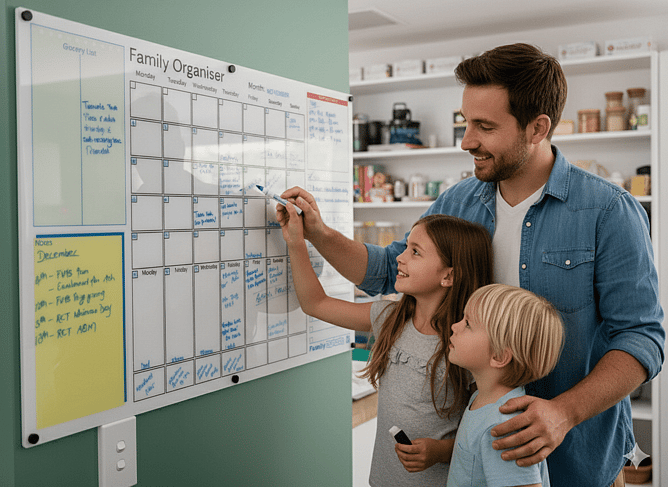
There is a very specific moment that happens when a week moves from private coordination to shared visibility.
For years, our planning didn’t live in chaos.
It lived in fragments.
Anyone who knows me well will tell you I always had systems. There was a paper planner permanently open on the bench with chores and weekly activities mapped out. There was a whiteboard on the fridge for meal planning and groceries. There was a wall calendar with everyone’s schedule marked in different colours and there were reminders on my phone
On paper, we were organised.
In reality, we were divided.
Four separate tools meant four separate sources of truth. To see the full picture of the week, I had to cross-reference. Check the diary. Glance at the fridge. Confirm the schedules on the wall calendar and make sure I wasn’t doubling up on Google Calendar, and then finally mentally merge the information.
And because I was the one who knew how the pieces connected, I became the bridge between them.
Behavioural research shows that task-switching increases cognitive load because the brain must repeatedly shift context and reorient itself. Research from the American Psychological Association explains:
“Although people think they are multitasking, they are actually switching from one task to another very rapidly. And every time they do, there’s a cognitive cost in doing so.”
— American Psychological Association
https://www.apa.org/topics/research/multitasking
This cognitive cost is not dramatic, but it is measurable. Each time the brain shifts between tasks or systems, it must disengage, reset and re-engage. When planning is scattered — diary here, fridge board there, calendar(s) somewhere else — the mental effort is not simply writing something down. It is integrating it. It is switching between systems and holding multiple streams of information at once.
The invisible labour is not the list.
It is the merging.
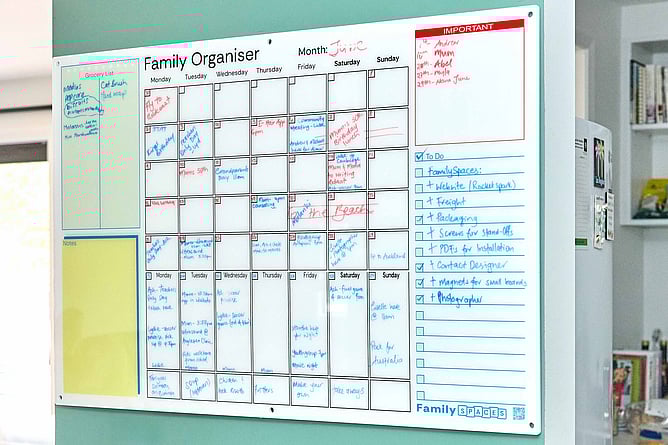
The first time our entire month was written clearly on a Planning Panel, something shifted — not dramatically, but practically.
It wasn’t about how it looked.
It was about what it did.
Everything was in one place. The month, the week, the dinners, the reminders — all sitting together instead of scattered across four different tools. I didn’t have to check the diary and then the fridge and then the calendars to piece it together.
It was simply there.
Clear. Structured. Easy to read from across the kitchen.
For the first time in a long time, I didn’t have to mentally assemble the week. I could see it in one glance. Not parts of it, the full picture.
That Sunday evening, we wrote everything down.
Soccer training.
Youth group.
A late work shift.
Swimming.
A birthday on Saturday.
Dinner plans.
Groceries.
A bill reminder.
And something shifted almost immediately — not in the schedule itself, but in the dynamic around it.
Instead of:
“What are we doing this weekend?”
It became:
“I checked the board — do you want me to take the kids to soccer training?”
Instead of:
“What’s for dinner?”
It became:
“Oh right, it’s tacos.”
Instead of:
“Why didn’t you tell me?”
It became:
“I saw that on the board.”
Small shifts.
But small shifts compound.
They compound at 8:15am when someone packs their sports gear without being chased.
They compound at 5:20pm when dinner isn’t negotiated from scratch.
They compound at 8:45pm when no one is surprised by tomorrow’s early start.
Billie described that shift perfectly:
“… it has been a godsend to finally have a large visual board to write all of our planning needs on… it is in Te Reo Māori! It looks amazing on the wall and in our space and has been such an asset to our family planning — I couldn't be without it.”
— Billie, Māmā of 2, Tokoroa (Google Review, January 2026)
Notice what stands out in her words: large, visual, finally.
Finally one place.
Finally visible.
Finally integrated.
When the plan is visible, responsibility begins to redistribute — not because someone demanded it, but because the structure allows it.
Visibility creates access.
Access invites participation.
Participation changes tone.
The week does not become lighter.
But it becomes steadier.
And steadiness changes everything.
Why Wall-Mounted Acrylic Boards Work Differently
Many families already use paper planners or digital calendars.
And those tools absolutely have their place.
A diary is portable. A digital calendar sends reminders. A phone app syncs with work commitments. None of those systems are wrong. In fact, most organised households are already using some combination of them.
The distinction is not about good versus bad.
It is about individual versus shared.
A diary lives in a bag.
An app lives on a phone.
A digital calendar lives behind a screen.
All of those systems rely on one person opening them.
A wall-mounted Planning Panel lives in shared physical space. It sits where everyone walks past it daily — beside the fridge, in the kitchen, near the hallway. It does not require logging in. It does not require scrolling. It does not depend on battery life.
It simply exists in view.
When you are choosing a family organiser board, visibility is everything. Visibility is what turns planning from private knowledge into shared awareness. If only one person can see the week, only one person can anticipate it.
A blank whiteboard might seem similar at first glance. It is also mounted on the wall. It can hold information. It wipes clean.
But the difference lies in structure.
A blank board requires you to design the week every single time. Redraw headings. Recreate columns. Decide how much space to allocate to dinners versus appointments. Rework the layout when the week gets busy. Every Sunday becomes a small design project.
That is cognitive effort.
Not dramatic effort. Not exhausting in one moment. But repeated effort.
Research on decision fatigue shows that even small, repeated choices draw from the same mental reservoir we use for patience and self-control. When the layout is pre-designed and intentional, that layer of decision-making disappears. You are not deciding how to plan. You are simply planning.
A structured Planning Panel removes that friction.
The layout is already intentional:
Month at a glance.
Current week schedule.
Flexible planning space.
To-do list.
Groceries.
Important dates.
Reminders.
Instead of inventing structure each week, you step into structure.
Structure reduces decision fatigue because it narrows choice. The framework is already there. You fill it in.
Amy, a māmā of two in Gisborne, shared something that speaks to the practical side of this:
“… I hate the traditional whiteboards as they get grubby over time but this one doesn't. The smaller size fits our fridge door nicely.”
— Amy, Māmā of 2, Gisborne
Her comment highlights something often overlooked in organising conversations: ease matters.
If something becomes grubby, it gets avoided.
If something feels messy, it stops being used.
If something requires redesigning every week, it eventually becomes another task.
And unused systems do not reduce mental load.
Used systems do.
When a planning surface is structured, durable and easy to wipe clean, it lowers the barrier to consistency. And consistency — not intensity — is what builds calm.
If it is easy to use, it gets used.
And when it gets used, it becomes rhythm.
And rhythm is what steadies busy homes.
Choosing the Right Size for Your Whānau
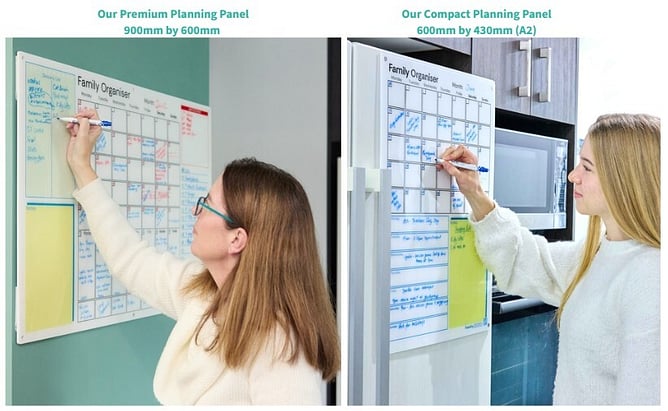
When people search for the best family organiser board, they often begin with one very practical question:
“How big do we need?”
Size is not just a measurement. It determines whether a planning system feels spacious or cramped, calm or cluttered. The wrong size can make even a good layout feel chaotic. The right size creates breathing room.
At FamilySpaces, we offer two intentional sizes, designed to suit different households and different physical spaces.
Premium Planning Panel — 900mm x 600mm
At nearly a metre wide, the Premium becomes a true family hub. It is designed for households where multiple schedules overlap and visibility needs to stretch across the whole week.
It holds:
Month at a glance
Current week schedule
Flexible planning section
To-do list
Grocery list
Important dates
Reminder space
For larger families, blended households, or shift-working parents, the Premium size offers something that is often underestimated: margin.
When several commitments sit in the same week — sport draws, work shifts, appointments, school events — space matters. If information overlaps or is squeezed into small boxes, the board quickly becomes hard to read. And when something becomes hard to read, it becomes easy to ignore.
The Premium size prevents that compression.
Nothing overlaps.
Nothing feels cramped.
The week can breathe.
It naturally becomes the anchor of the kitchen or main living space — the place everyone checks without thinking.
Compact Planning Panel — 600mm x 430mm (A2)
The Compact, at A2 size, offers the same structured clarity in a smaller footprint.
It works beautifully for:
Fridge mounting
Apartments
Smaller kitchens
Couples
Personal planning
Simpler weekly rhythms
It includes:
Month at a glance
Current week view
Large flexible reminder space
For many households, the Compact strikes the right balance between structure and simplicity. It provides clarity without dominating the room. It fits neatly into tighter spaces while still offering enough room to map the week clearly.
The key isn’t choosing the “biggest” option.
It’s choosing the option that fits both your physical space and your family rhythm.
If the board overwhelms the wall, it won’t feel integrated.
If it’s too small for your commitments, it will feel restrictive.
The right size feels natural in your home.
Of course, size and layout only matter if the board itself is built to last.
Engineered for Real Homes
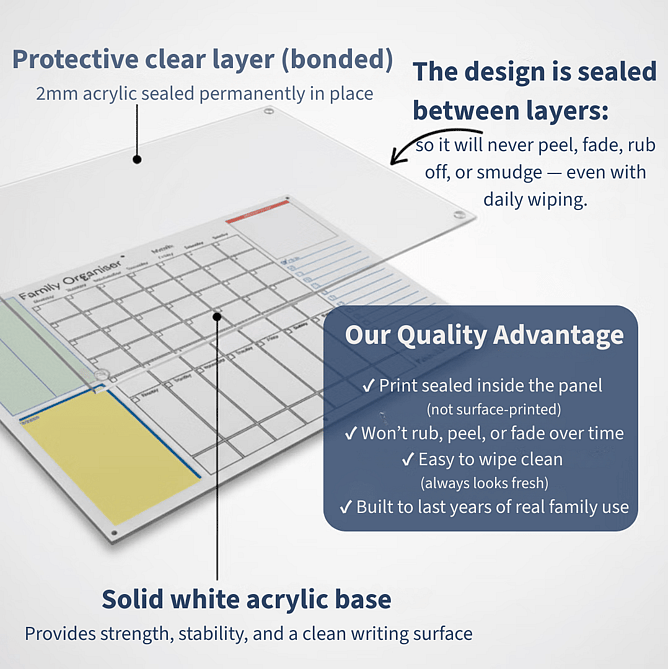
FamilySpaces Planning Panels are not single sheets of clear acrylic.
They are constructed using layered materials designed for durability and visibility in real homes:
2mm clear acrylic front
Reverse-printed design
Bonded to a 5mm solid white acrylic backing
That layered construction is intentional.
The design is printed in reverse and sealed behind the clear acrylic, which means it cannot rub off, scratch away or fade with cleaning. You are not writing directly onto ink. You are writing onto a protective surface designed to be wiped clean repeatedly.
The 5mm white backing is equally important.
Many acrylic boards on the market are fully transparent. They look minimal and sleek online. But in an actual kitchen — with tiled walls, coloured paint, textured splashbacks or shifting light — transparency can work against readability. Writing becomes harder to see. Marker contrast weakens. The background competes with the information.
When a board is difficult to read, it gets checked less often.
By bonding the printed layer to a solid white backing, Planning Panels maintain sharp contrast. Marker ink stands out clearly. Wall colour does not interfere. The board remains readable from across the room — whether you are glancing at it while cooking or calling out to someone packing their bag.
That clarity is not aesthetic.
It is functional.
A planning system only works if it can be read quickly and easily. If you have to step close, squint, or decipher faint writing, friction increases. And friction is what quietly erodes consistency.
This is not decorative acrylic designed to look good in styled photos.
It is engineered for daily family life — for busy mornings, wiped-down surfaces, marker re-writes and years of use.
Durability protects your investment.
Clarity protects your rhythm.
And rhythm is what makes planning sustainable.
Language, Identity & Te Reo Māori
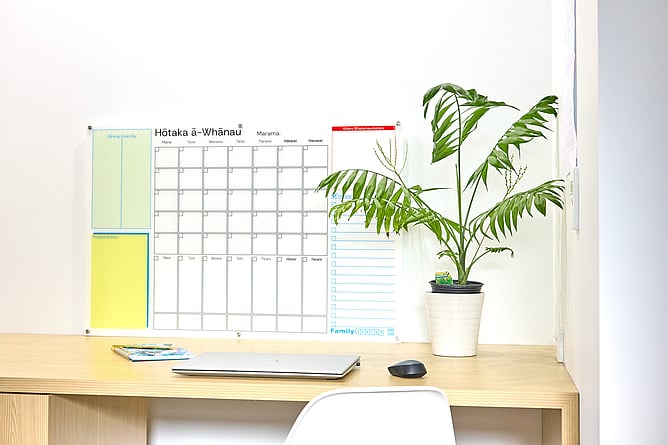
Language visibility matters.
Planning Panels are available in both English and Te Reo Māori, and that choice is not decorative. It changes what is normalised inside a home.
For some whānau, seeing te reo in everyday spaces is not a small detail — it carries weight. Language revitalisation does not only happen in classrooms or formal settings. It happens in kitchens. In hallways. In the everyday spaces where routines unfold.
Katrina shared this in her review:
“… As a Māori wahine, this was particularly meaningful to me, and I consider the calendar board to be a taonga within my whare.”
— Katrina, Rotorua
That word — taonga — speaks to something deeper than organisation.
When te reo appears on a wall-mounted planning system, it becomes part of the rhythm of the week. Grocery lists are written beside kupu Māori. Swimming days and sport practices sit under Māori headings. The language is seen daily, not ceremonially.
This isn’t tokenism.
It’s about normalising language in practical, lived-in parts of the home — on the kitchen wall, beside the fridge, in the space where daily life happens. It shifts te reo from being something separate to something integrated.
Not just in books.
Not just in formal environments.
But woven into the structure of ordinary life.
For some families, that visibility is a quiet but meaningful way to support language revitalisation. For others, it is about representation — seeing their identity reflected in the systems they use every day.
And for others, it is simply about choice.
A planning system should not only organise your week.
It should feel like it belongs in your whare.
Budgeting, Meal Planning & Financial Clarity
Financial pressure adds another layer to family life.
Planning is not only about sport draws and school notices. It intersects directly with grocery bills, utility payments and the everyday cost of running a household.
The ANZ Financial Wellbeing Indicator reports:
“A significant proportion of New Zealand households experience stress related to everyday expenses.”
— ANZ Financial Wellbeing Indicator
https://www.anz.co.nz/about-us/esg/financial-wellbeing/
Financial stress rarely appears as one large crisis. More often, it shows up as low-level vigilance. Mentally calculating while standing at the checkout. Double-checking whether the power bill has cleared. Wondering whether there’s enough left in the week’s grocery budget.
When meals aren’t planned, spending tends to increase. Last-minute decisions often mean convenience. Convenience costs more. When bills aren’t visible, they remain abstract until they become urgent. Urgency raises anxiety.
Clarity reduces that pressure.
A Planning Panel supports financial steadiness in simple, practical ways:
Weekly meal planning that prevents daily negotiation
Grocery visibility that reduces duplicate purchases
Bill reminders that prevent surprise
A central place to note upcoming expenses
It doesn’t replace a budgeting system. It anchors awareness.
When financial information is visible alongside the week’s schedule, it becomes part of the rhythm rather than an afterthought. You can see that sport fees and swimming overlap. You can anticipate camp payments. You can adjust dinners before the pressure builds.
Missy described the shift in a way that captures the broader impact:
“… This board has taken the mental load off my shoulders and turned planning into a whānau habit.”
— Missy, Te Awamutu
Notice what she names: not savings, not perfection — but mental load and habit.
That is the deeper impact.
Not perfection.
Participation.
When planning becomes visible, financial awareness becomes shared. Children see that groceries are planned. Partners see when bills are due. The household develops rhythm instead of reacting to surprise.
For families wanting more detailed support around budgeting, meal planning and calmer mornings, our Home Life Toolkit is a 28-page free PDF designed specifically for busy Kiwi whānau. It walks through practical ways to map your week, structure meal planning, and create financial clarity without overwhelm.
The Planning Panel makes it visible.
The Toolkit helps you build the rhythm behind it.
Together, they shift planning from reactive to deliberate.
And deliberate feels steadier.
Month One vs Month Three: How Habits Form
The first month with a Planning Panel is often about awareness.
Not transformation. Not perfection. Awareness.
You begin to notice how much you were previously holding in your head. How often the same questions were asked. How frequently you were the reminder, the translator, the person who connected scattered information. You notice the mental work that used to feel automatic.
At first, the board feels like a tool you are consciously using. You gather the family. You fill it in deliberately. You refer to it intentionally.
But over time, something shifts.
By month three, the change is less visible — and more structural.
Children start checking the board before asking what is happening tomorrow. Partners glance at it before scheduling something new. Meal planning becomes less of a negotiation and more of a rhythm. Grocery items are written down when they run out rather than remembered later — or forgotten entirely.
The board stops feeling like a project.
It becomes background infrastructure.
This is how habits form. Behavioural research consistently shows that habits are built not through motivation alone, but through consistent environmental cues. When a cue is stable and visible in the same place each day, behaviour gradually attaches to it.
The Planning Panel becomes that cue.
Instead of relying on memory, the household relies on reference. Instead of reacting to surprise, the week is anticipated. The system moves from being driven by reminders to being supported by routine.
And routine is calming.
Calm does not come from having less to do. It comes from knowing what needs to be done and when.
That’s why the best family organiser board is not defined by acrylic thickness or layout alone.
It is defined by behavioural shift.
When a tool supports habit formation — when it reduces friction, anchors cues and distributes awareness — it lasts. Not because it is new. But because it becomes normal.
And normal is sustainable.

Sustainability & Long-Term Value
There is also a sustainability element that often gets overlooked when families think about planning tools.
Many households cycle through the same pattern each year. A new paper planner in January. A disposable wall calendar from the bookstore. A small diary that works for a few months before the pages fill up. Sticky notes that gather near the fridge and gradually lose their relevance.
These tools are useful.
But they are temporary.
They are designed to expire.
Each year, the system resets. A new format. A new layout. A new purchase. And the old one quietly ends up in a drawer or in the bin.
Acrylic Planning Panels operate differently.
They are reusable by design. You wipe. You rewrite. You repeat. The structure remains constant while the information evolves.
There is no annual replacement cycle. No need to buy a new version each January. No stack of outdated calendars accumulating in cupboards. The system stays. The week changes.
Because the design is sealed between layers — 2mm clear acrylic bonded to a 5mm white backing — it does not fade, peel or wear down with cleaning. You are not writing on exposed ink. You are writing on a durable surface engineered for repeated use.
That durability is not accidental.
It is intentional.
A planning system should not be fragile. It should withstand real kitchens, regular wiping and constant rewriting. It should survive years of school terms, sport seasons and shifting schedules.
When something lasts, it stops being a novelty and becomes infrastructure.
It settles into the rhythm of the home.
And when a system becomes part of the rhythm, it no longer feels like something you “use.”
It simply becomes how you organise.
That longevity is not just about materials.
It is about sustainability — financially, practically and environmentally.
One system.
Used well.
Over time.
That is what builds steadiness.
Designed in Aotearoa, For Aotearoa
Kiwi life has its own rhythm.
It moves in school terms rather than semesters. In regional anniversary weekends. In Saturday sport draws that depend on the weather. In church camps, kapa haka practices and community fundraisers. In Matariki gatherings and long summer evenings at the beach. In winter sport seasons where wet uniforms never seem to dry.
The calendar is not abstract.
It is lived.
Planning Panels are designed here, for those rhythms. Not for generic Pinterest lifestyles with colour-coded perfection. Not for American school calendars with different term structures. Not for corporate offices that operate on quarterly reports rather than swimming blocks and mufti days.
They are designed for real homes where life is layered and sometimes messy. Homes where the week might include netball training, a late shift, a youth group meeting and a shared family dinner — all competing for space.
For homes in Kaitaia to Invercargill.
Different regions. Different climates. Different communities.
But the same underlying pattern: families juggling full schedules and wanting clarity.
Local understanding matters because rhythms differ. School terms differ. Cultural moments differ. Seasonal pressures differ. A planning system that works in theory must still work in practice — in real kitchens, on real walls, in households balancing work, kura and community.
Designing locally is not about branding.
It is about relevance.
When a planning system reflects the rhythm you actually live, it feels natural rather than imposed.
And when something feels natural, it gets used.
Frequently Asked Questions
Is A2 (600mm x 430mm) big enough for a busy family?
For many households, yes. The Compact A2 size works beautifully when wall or fridge space is limited, or when your family schedule is structured but not heavily layered. It comfortably holds a monthly overview, the current week and reminders in one clear view.
If you have multiple children with overlapping sport, shift work, shared parenting or several extracurricular commitments running at once, the 900mm x 600mm Premium size offers more breathing room. The additional width allows information to sit clearly without crowding. The goal is not simply “bigger” — it is legibility. When information feels squeezed, it becomes harder to reference. When it has space, it stays usable.
Will marker ink stain the board?
No. The acrylic surface is designed to wipe clean easily with a soft cloth when using standard whiteboard markers. Because you are writing on sealed acrylic rather than exposed print, residue does not absorb into the surface. With regular wiping, the board maintains clarity over time.
Does the design rub off over time?
No. The layout is reverse printed and sealed behind the acrylic layer, bonded to a 5mm solid white backing. You are never writing on the design itself. That means it cannot scratch, peel or fade through normal use and cleaning. The structure remains intact year after year.
Can this replace digital calendars?
It complements them beautifully. Many families continue using digital alerts for work meetings or automated reminders. The difference is visibility. A wall-mounted Planning Panel creates shared awareness — children can see it, partners can reference it, and the week becomes ambient information rather than something hidden inside one device. Digital tools notify. Wall systems stabilise.
Is this just another organising trend?
No. Trends focus on aesthetics. This is about infrastructure. When planning is visible and shared, cognitive labour redistributes. Conversations reduce. Micro-decisions decrease. The emotional tone of the week steadies.
That is not a trend.
It is a structural shift in how a household carries responsibility.
What Makes a Reliable Family Organiser Board Provider in New Zealand?
If you are researching family organiser boards, it is easy to be drawn to polished photos and styled kitchens. Clean lines. Minimal aesthetics. Perfect lighting.
But glossy images do not tell you how a board performs in a real household on a Wednesday night.
A reliable provider is not defined by how the board looks in a photoshoot. It is defined by how it functions after months — and years — of daily use.
So look beyond styling.
Ask different questions.
Is the board designed locally, with an understanding of how school terms, sport seasons and community life actually run? Or is it a generic template created for a different rhythm entirely?
Is it engineered for durability? Acrylic thickness, backing support and print sealing matter. A board that scratches, fades or warps under regular wiping will not remain part of your system for long.
Is the structure practical? Does the layout reduce decision fatigue, or does it require you to redesign the week each time? A planning system should remove cognitive effort, not add to it.
Does it reflect real family life? Is there space for groceries, reminders, overflow and the unpredictability that inevitably arises?
And finally — are there detailed, genuine customer reviews? Not just star ratings, but lived feedback. Stories about how the board functions over time. Real reflections from real homes.
Substance matters more than styling.
Because a family planning system is not décor.
It is infrastructure.
And infrastructure needs to work.
In Closing
We didn’t create Planning Panels because we love stationery.
We created them because we were tired of carrying everything in our heads.
Tired of being the bridge between fragmented systems.
Tired of being the reminder.
Tired of holding the mental map while everyone else just asked, “What’s happening this week?”
If you’re searching for a family organiser board, you’re probably not looking for acrylic.
You’re looking for relief.
Relief from being the default planner.
Relief from mental clutter that never quite switches off.
Relief from invisible responsibility that accumulates quietly.
A Planning Panel will not remove the school terms.
It won’t cancel sport seasons.
It won’t stop life from being full.
But it will make the fullness visible.
And when life becomes visible, it becomes shareable.
When it becomes shareable, it becomes lighter.
Not because the workload disappears — but because it is no longer carried alone.
Explore our Planning Panels and choose the size and structure that fits your whānau.
Because surviving busy seasons is not about trying harder.
It is about building systems that help everyone carry them together.